Football Match Predictions AI: A Better Process
Football match predictions AI helps organize team data, model probabilities, and compare fair estimates with market odds before placing a disciplined bet.
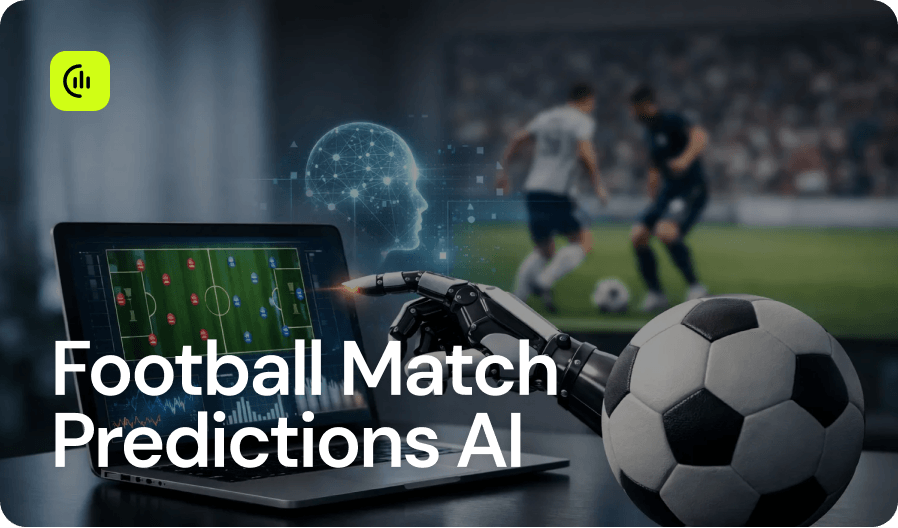
A late injury update, a congested fixture list, and a heavily backed favorite can change a football betting decision in minutes. Football match predictions AI is useful when it turns that noise into a structured view of the match: what is known, what is uncertain, and whether the available odds leave room for value.
That distinction matters. A prediction is not a promise, and a model is not a shortcut to risk-free betting. The practical value of AI is its ability to process more relevant information than most bettors can review consistently, then present probability-based estimates that support a clearer decision.
What Football Match Predictions AI Should Actually Do
The strongest AI-assisted prediction systems are not designed to announce a winner with theatrical confidence. They are designed to estimate the likelihood of different outcomes and explain the factors influencing those estimates.
For a standard 1X2 market, that means assigning probabilities to a home win, draw, and away win. A model may also estimate expected goals, the chance of both teams scoring, total-goal ranges, clean-sheet likelihood, or the probability of a team covering a handicap. Each output is an estimate based on historical and current evidence, not a statement of certainty.
The quality of that estimate depends on the inputs. Useful football models may evaluate recent performance, expected goals data, shot quality, home and away splits, league strength, rest days, injuries, suspensions, likely lineups, tactical styles, and head-to-head context when it has genuine relevance. They can also account for the market itself, because betting odds contain a large amount of collective information.
AI earns its place by combining these inputs quickly and consistently. It does not eliminate judgment. It makes it easier to focus judgment where it belongs: on whether the data is credible, whether the context is unusual, and whether the market price is favorable.
From Prediction to Value: The Step Most Bettors Miss
A 60% chance of winning is not automatically a bet. The price determines whether that probability is useful.
If a model gives Team A a 60% chance of winning, its fair decimal odds are approximately 1.67. If a sportsbook offers 1.50, the market is asking bettors to pay more than the estimated probability justifies. If it offers 1.85, there may be positive expected value, assuming the model estimate is well calibrated and the line has not missed important information.
This is why disciplined betting research begins with probability, then moves to price. Starting with the odds and looking for reasons to support a preferred selection invites confirmation bias. Starting with a probability estimate creates a more rational question: does the market disagree enough to make this worth considering?
Small differences matter over time. A bettor does not need to be certain that a selection will win. They need a repeatable process that identifies situations where the implied probability in the odds appears lower than a reasonable estimated probability. Even then, variance remains unavoidable. Good decisions can lose, and poor decisions can win in a single match.
How to Use AI Predictions Before a Football Match
Treat an AI prediction as the first organized layer of research, not the final instruction. A practical workflow is to review the model's probabilities, compare them with the market's implied probabilities, and then investigate the assumptions behind any meaningful gap.
Start with the match profile. Is one side performing well because it has created high-quality chances, or because it finished an unsustainably high percentage of shots? Has a team recently faced weak opposition? Is its defensive record supported by low-quality chances conceded, or has it benefited from strong goalkeeping and favorable variance?
Next, check the context that aggregated data can understate. A starting striker missing from the lineup, a goalkeeper rotation, travel after a midweek European match, or a coach changing systems can materially affect a fixture. Models can incorporate many contextual signals, but confirmed late information still deserves attention.
Then compare markets instead of forcing a bet in the most familiar one. A match with a clear favorite may offer little value in the moneyline, while the total-goals market or a handicap better reflects the underlying mismatch. Conversely, an AI model may see an evenly balanced match where the market has overreacted to a recent result, making a draw-related angle more interesting than picking a side.
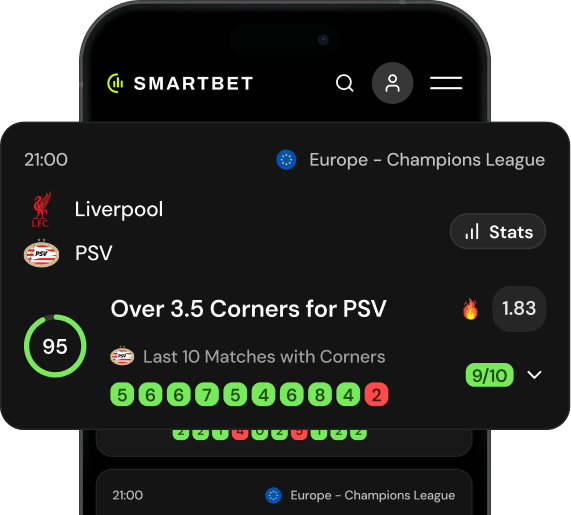
SmartBet.gg is built around this process: organizing match data and probability signals so users can evaluate a fixture efficiently rather than rely on headlines, fan sentiment, or unverified tipster claims.
Prédictions Footballistiques Basées sur les Données
Analyses de matchs basées sur l'IA utilisant la forme de l'équipe, les statistiques clés et les paris à valeur pour soutenir les décisions de paris plus intelligentes.
Consultez les prédictions
Why Model Outputs Need Context
Football is a low-scoring sport, and that creates volatility. A red card, deflection, penalty, or missed chance can reshape a match that otherwise follows the expected pattern. No system can fully remove this uncertainty, especially in a one-game sample.
League quality also changes the reliability of available data. Major leagues generally provide deeper historical records, more consistent lineup information, and more liquid betting markets. Lower divisions and youth competitions can present thinner data, rapid squad changes, and larger gaps between opening and closing prices. An AI output may still be informative, but confidence should be lower when the underlying information is limited.
Recent form requires similar care. Five matches can reveal a tactical change or an important injury. It can also reflect a short run of favorable opponents, red cards, or unusual finishing. Longer-term performance provides stability; recent results provide timeliness. Better prediction systems weigh both rather than treating either one as the whole story.
There is also a difference between correlation and cause. A team may have won four consecutive matches, but the useful question is why. If its expected-goals numbers, chance creation, and defensive control improved alongside the results, the run may be meaningful. If the wins came with poor underlying numbers and late goals, the market may eventually correct the narrative.
Evaluating Whether an AI Model Is Worth Trusting
A prediction tool should be judged by more than its headline accuracy. In football, simply choosing favorites will produce a respectable win rate, but that does not prove a model identifies betting value.
Calibration is more revealing. If a model labels 100 selections as 70% likely, roughly 70 of them should win over a sufficiently large sample. The same principle applies across probability ranges. A well-calibrated model does not need to be perfect. It needs to avoid systematic overconfidence or underconfidence.
Transparency also matters. Users should be able to understand whether a prediction reflects team strength, expected goals, recent form, squad availability, market movement, or a combination of factors. A black-box score with no context may look precise while offering little support for an actual betting decision.
Finally, separate analytical quality from short-term results. A few winning picks prove very little, just as a bad weekend does not invalidate a sound process. Evaluate tools over a large sample, look for coherent probability logic, and track whether the model's estimated edge is consistently compared against real available prices.
Common Mistakes When Using AI for Betting Research
The most common mistake is treating a high probability as a guaranteed outcome. A 75% favorite still loses about once in every four comparable situations. Stakes should reflect uncertainty, not confidence alone.
Another mistake is using stale odds. Markets move, and a selection that offered value in the morning may be fairly priced by kickoff. Record the price available when making a decision rather than evaluating it against a number that no longer exists.
Bettors also overvalue the apparent precision of decimal probabilities. A model showing 57.4% is not claiming to know the future to one decimal place. It is expressing a relative estimate. The practical question is whether the gap between that estimate and the market is large enough to survive normal model error.
A final risk is increasing stakes after a losing run to recover quickly. AI can improve the research process, but it cannot change the mathematics of bankroll risk. Set a consistent staking approach, use only money allocated for betting, and avoid letting a single match dictate the next decision.
A More Disciplined Way to Read the Match
The best use of football match predictions AI is not to replace the bettor with an algorithm. It is to replace scattered research and emotional reactions with a repeatable framework. Estimate the probability, inspect the context, compare the price, and accept that passing on a match is often the most disciplined decision available.
When the evidence and the odds do not align, patience is part of the edge. Let the model organize the signal, but keep the final decision grounded in price, uncertainty, and responsible bankroll management.

Articles Associés