Bet Tracker: How to Track Your Bets and Calculate ROI
A bet tracker records every bet and calculates profit, ROI and yield. Learn how to calculate betting ROI, what a good ROI is and how many bets you need.

Why you need a bet tracker: the short answer
A bet tracker is a tool that records every bet you place, including the stake, odds, market and result, and turns that history into numbers: total profit, betting ROI, yield and win rate. Without one, you rely on memory, and memory keeps the big wins and quietly forgets the run of small losses. A tracker is the only honest way to know whether your betting strategies actually work.
This guide shows what to log, how to calculate ROI with worked examples, what a good ROI looks like, how many bets you need before the numbers mean anything, and how to use the data to improve your betting performance. It is written for football bettors who want to measure results properly, whether they use a spreadsheet or a dedicated tool.
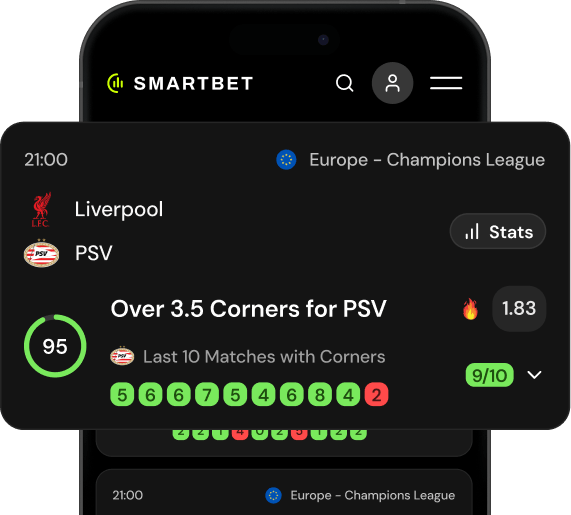
Football Predictions Based on Data
AI-driven match analysis using team form, key statistics and value bets to support smarter betting decisions.
Check predictions
What is a bet tracker and how does it work?
A bet tracker can be a simple spreadsheet or dedicated software. Either way, it keeps all your bets in one place and calculates the results for you. A good tracker shows at a glance:
- total stakes and total returns;
- net profit or loss;
- betting ROI as a percentage;
- how many bets you have placed and settled;
- performance by league, market, odds range, bookmaker and date.
Some tools settle bets automatically once results come in; with others you enter the result yourself. What matters is that the record is complete, because a tracker with gaps gives you the wrong answer with more confidence.
Why memory is not enough
Most sports bettors overestimate their results. The winning accumulator from last month is easy to remember; ten losing singles from a quiet midweek are not. Confirmation bias and selective memory make many bettors believe their approach is profitable when the full betting history says otherwise.
Logging all your bets, including small stakes and "fun" bets, is absolutely essential. Only a complete record shows patterns such as:
- long-odds accumulators losing money steadily;
- one market, such as over 2.5 goals in a specific league, producing a positive ROI;
- pre-match bets doing better than in-play bets;
- a losing month that is normal variance rather than a broken strategy.
Seeing the numbers also helps you stop impulsive bets. It is harder to chase losses when the tracker shows exactly how much they cost.
Betting ROI, yield and profit: the core metrics
Metric | Formula | What it tells you |
|---|---|---|
Net profit | Total returns − total stakes | How much profit in money terms |
Betting ROI / yield | Net profit ÷ total stakes × 100 | Profit per unit of money invested in bets |
ROI on bankroll | Net profit ÷ starting capital × 100 | How much your betting funds have grown |
Win rate | Winning bets ÷ settled bets | How often you win, meaningless without the odds |
ROI and yield. In sports betting, ROI (return on investment) and yield are usually the same calculation: net profit divided by total stakes. Many bettors use the terms interchangeably, and most trackers show this number as ROI. Some people also measure return on investment against their starting bankroll, which grows as you place more bets. Both are valid, but compare like with like.
Win rate. A high win rate does not mean a profitable bettor. Winning 55% of bets at average odds of 1.80 loses money over time (0.55 × 1.80 = 0.99, about −1% per bet). Winning 40% at average odds of 2.70 makes money (0.40 × 2.70 = 1.08, about +8%). ROI is the number that matters.
How to calculate ROI in sports betting
The ROI formula:
ROI (%) = (total returns − total stakes) ÷ total stakes × 100
Example 1: positive ROI. You place 200 bets at €25 each. Total stakes: €5,000. Total returns: €5,250. Net profit: €250. ROI = 250 ÷ 5,000 × 100 = +5%.
Example 2: negative ROI. You place 120 bets on cards and corners markets. Total stakes: €2,400. Total returns: €2,280. Net profit: −€120. ROI = −120 ÷ 2,400 × 100 = −5%. Those markets are costing more money than they return.
Example 3: ROI on bankroll. If the bettor in example 1 started with a bankroll of €1,000, the same €250 profit is a 25% return on starting capital, but still a 5% yield on total stakes. Keep both in mind: one shows how fast your bankroll grows, the other how efficient each bet is.
You can calculate ROI for any slice of your history, for example only BTTS bets, only one league or only bets above odds of 2.00. A good bet tracker does this filtering for you, which turns it into a sports betting ROI calculator for every part of your betting portfolio.
What is a good ROI in sports betting?
Long-term, a positive ROI of a few percent is a strong result. Realistic benchmarks:
- Below 0%: where most bettors end up, because bookmakers build a margin into every price.
- 0% to +3%: break-even to small profit; you are beating the margin, which already puts you ahead of many bettors.
- +3% to +10%: a good ROI over hundreds of bets, and hard to sustain.
- Above +10% over a large sample: rare. Big numbers over a few dozen bets are usually luck, not skill.
Treat any claim of a 20% or 30% ROI over a short period with suspicion. Matched betting and arbitrage betting can show higher percentages on individual offers, but they work differently from regular betting and depend on bonus bets and promotions that do not last forever.
How many bets do you need before ROI means anything?
Variance is large in betting. As a rough guide, at odds around 2.00 the uncertainty in your ROI shrinks with the square root of the number of bets:
Number of bets | Typical range of ROI from luck alone |
|---|---|
100 | about ±10% |
500 | about ±4.5% |
1,000 | about ±3% |
2,000 | about ±2% |
Approximate one standard deviation for level stakes at odds near 2.00. Higher odds mean wider ranges.
So a +8% ROI after 100 bets says very little; the same result after 2,000 bets is meaningful. Judge a strategy on hundreds of bets, and keep checking whether the result holds across seasons, not just one good month. That is the difference between long term success and a lucky streak.

What to record for every bet
At minimum, log:
- date and league;
- match and market (over/under, BTTS, corners, cards, 1X2);
- selection and odds taken;
- stake;
- bookmaker;
- result (won, lost, void, push) and the amount returned.
For deeper analysis, add:
- closing line odds, to see whether you beat the closing line, one of the best early signs of an edge;
- probability or expected value at the time of the bet, if you used a source such as SmartBet.gg;
- bet source, such as your own analysis, a value bet or a friend's tip;
- notes on your reasoning.
Spreadsheet or bet tracker app?
Spreadsheet: free and flexible, but slow and easy to get wrong. It works if you place a handful of bets a week.
Bet tracker app: logs bets in seconds, settles bets automatically in some tools, and calculates ROI, profit and charts in real time. It is a game changer if you bet often or across several markets.
Whichever you choose, the tracker is also a responsible betting tool: it shows straight away if your stakes, volume or losses start creeping up.
How to use your bet tracker to improve your betting strategies
Review your data every month or every 100–250 settled bets. Filter by league, market, odds range and bookmaker. Look for:
- markets with a positive ROI over a decent sample, where you can focus more;
- markets with a clear negative ROI, where you should cut back or stop;
- odds ranges where you do better or worse;
- whether you consistently beat the closing line.
Then make one change at a time and keep tracking, so you know which change made the difference. Informed decisions come from data, not from how a week felt.
Common mistakes that distort your ROI
- Skipping losing bets or small bets. Your ROI looks better than it is.
- Mixing currencies without converting them.
- Counting returned stakes as profit. Returns include the stake; profit does not.
- Ignoring cash-outs and free bets. Both change the real result and need their own label.
- Judging too early. A few dozen bets cannot tell you how much profit a strategy will make.
SmartBet.gg's bet tracker
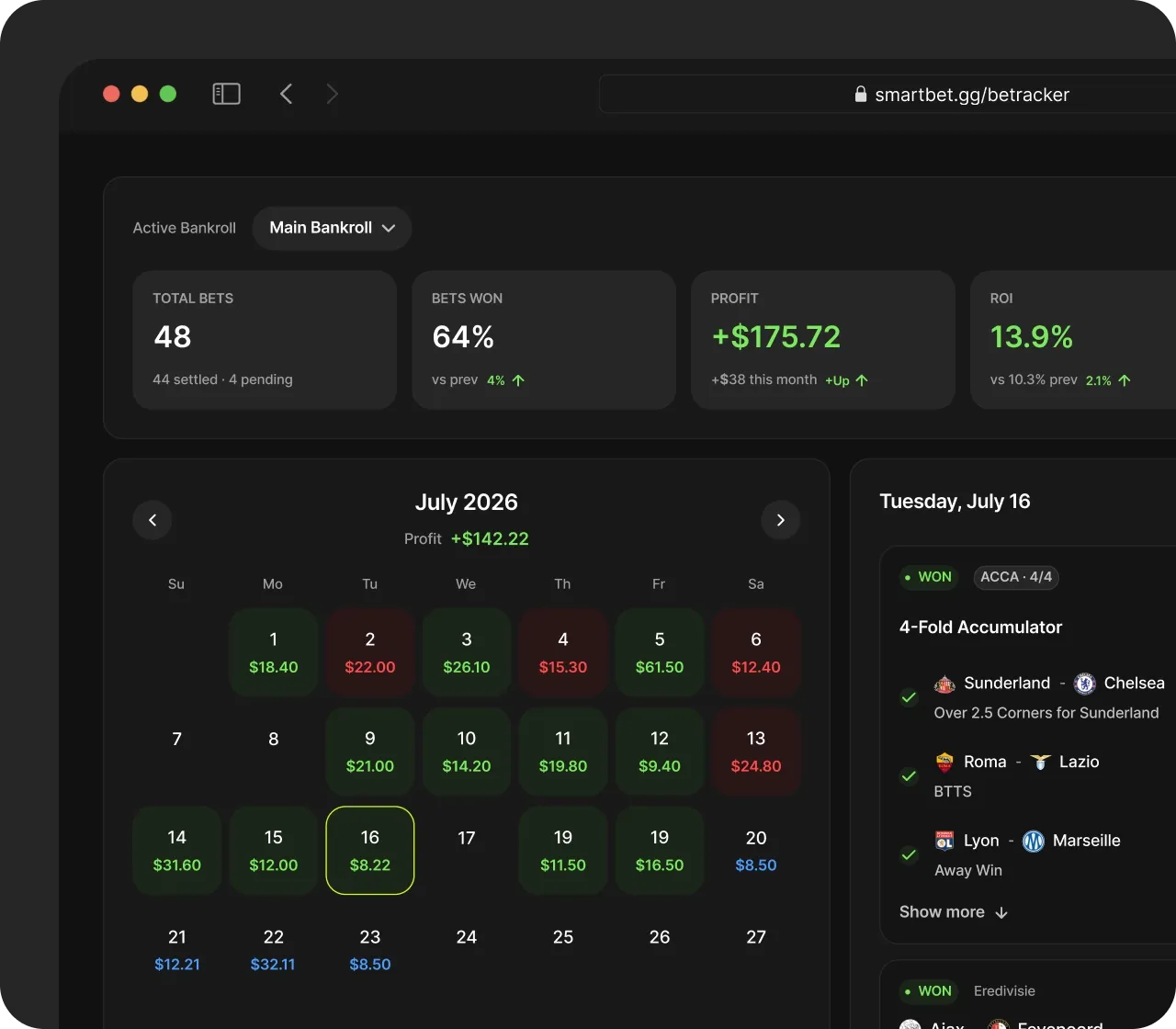
SmartBet.gg Premium includes a built-in bet tracker, so your analysis and your betting history sit in one place:
- Log singles and accas in seconds.
- Auto settlement: bets move from pending to won or lost by themselves once results come in.
- Full analysis: profit, ROI, win–loss–push record, total staked and streaks, with a profit graph.
- Calendar view: daily profit and loss, with pending bets shown separately.
- Multiple bankrolls: separate bankrolls for value bets, accas or any strategy you test, each with its own ROI.
- Filter, sort and edit: sort your history by market, date or result and fix a stake or result in one click.
Because the tracker sits next to SmartBet.gg's value bets and predictions, you can check whether bets with positive expected value actually perform better for you than your own picks. Read more about staking in our guide to bankroll management.
FAQ: bet tracker and betting ROI
What does ROI stand for in betting? Return on investment: net profit as a percentage of the money you have staked.
How do you calculate ROI on bets? Subtract total stakes from total returns, divide by total stakes and multiply by 100. €5,250 returned from €5,000 staked is a 5% ROI.
What is a good ROI for betting? A consistent positive ROI of a few percent over hundreds of bets is good; +3% to +10% is strong and hard to sustain.
What is the difference between ROI and yield? In most betting contexts they are the same: profit divided by total stakes. Some bettors also measure ROI against their starting bankroll.
Does a bet tracker make me profitable? No. It shows you the truth about your results so you can make better decisions, but it cannot remove the risk in betting. Stake only what you can afford to lose.
Start tracking with the numbers
SmartBet.gg is a data-driven football predictions platform, not a bookmaker. It shows probabilities, odds and expected value across 120+ leagues and publishes its results openly, including losing picks. See today's football predictions: 2 free picks daily, and Premium unlocks every match and market, plus the bet tracker.
Treat betting as entertainment, stake only what you can afford to lose and use stats as a guide, not a promise.

Related Posts