Booking Points Explained: How Cards Betting Works
Booking points: a yellow card is usually 10 points and a red 25. Learn how cards markets work and which leagues show the most cards per match

Booking points in a nutshell
In most booking points markets a yellow card is worth 10 points and a red card is worth 25 points. A player who receives two yellow cards leading to a red is usually settled at 35 points total (10 + 25), which is also the maximum any single player can accumulate. Exact scoring rules can differ between betting sites, so always check before you place bets.
Booking points betting turns yellow and red cards into a numerical value you can wager on, alongside regular football betting markets such as goals, corners and match result. Bookmakers may use different scoring systems for booking points, which is why reading the fine print matters more here than in most markets.
This guide is for beginners who see booking points betting options on a betting site but are unsure how booking points work or how they differ from total cards and other card betting markets. SmartBet.gg is a stats-based platform for analysing cards data across 120+ leagues. It is not a bookmaker and does not accept bets, and throughout this article we show how to use numbers instead of gut feeling in card markets.
Booking points scoring table: how many points per card?
Most UK and European bookmakers use a near-identical scoring system, but always check the house rules before you place any booking points bets.
Event | Booking points |
|---|---|
Yellow card | 10 points |
Straight red card | 25 points |
Second yellow leading to red | 35 points (10 + 25, max per player) |
Previsioni Calcio Basate su Dati
Analisi delle partite guidata dall'IA utilizzando la forma della squadra, statistiche chiave e scommesse di valore per supportare decisioni di scommessa più intelligenti.
Visualizza previsioni
A player cannot exceed 35 booking points in one football match, even if they technically receive two yellows and a red. This cap is a typical rule but not universal across every operator.
Cards shown to managers, coaching staff and unused substitutes usually do not count for booking points markets. Cards shown after the final whistle are also often excluded. Typically only cards shown during regular time, the 90 minutes plus added time, count towards booking points.
Check the specific bookmaker rules for booking point markets before betting. Some operators handle extra time, abandoned matches or VAR revisions differently, and those details can change how your bet is settled.
Booking points vs total cards, team cards and first card markets
Booking points betting sits alongside other card betting options that bookmakers offer punters: total cards over/under, team card totals, first card and card handicap markets. Each one frames the same disciplinary actions differently.
In total cards markets, for example over/under 3.5 or 4.5 cards, every yellow or red card simply counts as one card regardless of colour. Settlement is based purely on the number of cards shown. Booking points markets, by contrast, weight red cards far more heavily.
A concrete example: a game finishes with 3 yellow cards and 1 straight red card, no double bookings. The total number of cards is 4, but the total booking points are 55 (3 × 10 + 25). A bettor who backed over 3.5 cards wins. A bettor who backed over 60 booking points loses. Same match, different outcome, and that distinction regularly catches beginners out.
In team booking points markets and team cards markets, you only count the cards or points of one team. This is useful when two teams have very different disciplinary records and you want to isolate the more aggressive side.
First card markets let you predict which team receives the first card, or whether the first card arrives before a certain minute. Card handicap markets give one team a virtual head start, say +10 or +20 booking points, and bets settle on the adjusted totals, similar to goal handicaps. Each bookmaker sets its own line for booking points, so always confirm the exact market type on your bet slip.
What drives booking points: referees, rivalry, stakes and styles
Understanding what actually creates yellow and red cards matters more than memorising how many points each card is worth. The number of booking points in a match depends on several overlapping factors.
Referee tendencies come first. Referees issue cards at noticeably different rates, so checking referee stats and referee behaviour before a match is one of the simplest pieces of research available. Cards also often rise in the second half as fatigue and frustration build, which is worth factoring in for live betting.
Derby games typically generate higher booking points totals. Local derbies, historic bad blood and recent controversial meetings increase fouls, dissent and bookings. The game intensity in these fixtures is visibly different from a mid-table dead rubber.
Match context matters. High-stakes matches such as a title decider, a relegation battle or a knockout second leg often see more cynical fouls and more cards, because the pressure pushes players to take risks.
Playing styles complete the picture. Pressing, aggressive play and direct tackling generate more fouls and more cards, and aggressive teams accumulate more booking points consistently across a season. Teams' disciplinary records over dozens of matches show these patterns clearly. Slow, possession-heavy sides usually produce fewer points.
League culture ties all of this together, as the table below shows.

Average cards per league (2025/26): why the league matters
The same line, say over 4.5 cards or over 45 booking points, does not mean the same thing in every competition. Some leagues are much card-heavier than others.
League | Average cards per match |
|---|---|
Liga Portugal | 4.88 |
La Liga | 4.84 |
Ekstraklasa | 4.37 |
Champions League | 4.11 |
Serie A | 4.04 |
Championship | 3.95 |
Premier League | 3.89 |
Ligue 1 | 3.88 |
Bundesliga | 3.82 |
Eredivisie | 3.39 |
Source: SmartBet.gg data, 2025/26 season.
Liga Portugal and La Liga average almost five cards per game, while the Eredivisie sits at 3.39. A 4.5 cards line means very different things in each league: what looks like a comfortable over in Portuguese football is a stretch in the Netherlands. The Premier League sits in the middle, and even there individual fixtures swing widely depending on the referee and what is at stake.
You can browse league and team card statistics on SmartBet.gg to see how these averages break down by team and competition.
How cards markets are priced: probabilities, odds and value
Bookmakers turn their estimate of the probability of, say, over 3.5 cards or over 40 booking points into decimal odds, then add a margin. Think in probabilities rather than just prices.
A step-by-step example: if the chance of over 3.5 cards is 62%, fair odds are 1 ÷ 0.62 ≈ 1.61. If a betting site offers 1.75, the implied probability is around 57%, which gives you a small edge of roughly 8%. If the best price available is 1.50 (implying 67%), the bet has negative expected value. The same logic applies to booking points lines such as over 30, over 40 or over 60: you need both a probability estimate and the available odds to judge value.
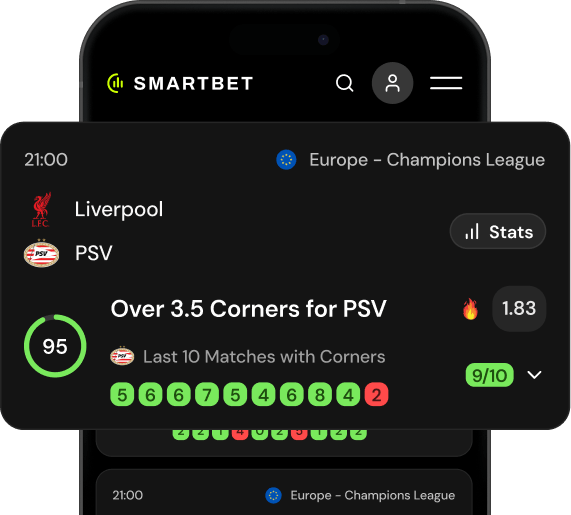
SmartBet.gg uses team discipline history, home and away splits and league averages to calculate probabilities for cards markets, shown next to bookmaker odds and expected value. It does not promise profit. Pre-built lines such as over/under 4.5 cards help you spot when a price looks too short or too long.
Expected value (EV) in simple terms: if probability × odds is greater than 1, the bet has positive EV. Focus on that number instead of chasing "sure things", because in football there is no such thing.
Beginner mistakes in booking points betting (and how to avoid them)
Avoiding these mistakes will not guarantee wins, but it removes unnecessary losses.
Not checking the rules. Betting on booking points without checking how extra time and post-whistle cards are handled is the most basic error. One betting site may exclude extra time; another may include it.
Ignoring league and referee. The base card rate differs between leagues and referees. An over 40 booking points line in the Eredivisie is a very different proposition from the same line in La Liga.
Overreacting to one fixture. One fiery derby does not change the long-term picture if most meetings between the two teams were calm. Averages over a meaningful sample are more reliable than a single memorable match.
Chasing in-play. An early yellow does not mean the match will produce many booking points. Cards often plateau if one team takes control and the intensity drops.
Confusing markets. Some punters misread card handicap or team booking points markets and think they are betting on the number of cards rather than weighted points or relative team totals. Always double-check the bet slip wording.
Stats improve judgement but do not remove risk. Even a low-card referee can have a busy match, and booking points totals in any single game are highly volatile.
Previsioni Calcio Basate su Dati
Analisi delle partite guidata dall'IA utilizzando la forma della squadra, statistiche chiave e scommesse di valore per supportare decisioni di scommessa più intelligenti.
Visualizza previsioniFAQ: quick answers about booking points and cards betting
How many booking points is a yellow card?
A yellow card is worth 10 booking points in almost every football betting market. A few bookmakers use a different scale, so confirm the number of points on your chosen platform before you wager.
How many booking points is a red card?
A straight red card is usually worth 25 booking points. If a player receives two yellow cards leading to a red, the total for that player is settled at 35 points (10 + 25), not 45. The maximum per player is typically capped at 35.
Do manager cards count for booking points?
Usually not. Cards given to managers, coaching staff or substitutes on the bench generally do not count towards booking points markets, but some card markets now include staff, so check the rules for the specific market.
Do cards after the final whistle count?
Usually not. Most booking points markets only include cards shown during the 90 minutes plus added time; post-match incidents and extra time are generally excluded. This varies by betting site, so read the settlement terms.
Do stats guarantee a cards bet wins?
No. Statistics help you estimate probabilities and make more disciplined decisions, but every match carries variance that no model eliminates.
Using SmartBet.gg for cards analysis
SmartBet.gg is a stats-based football analytics platform, not a bookmaker. It provides probabilities, expected value and detailed cards statistics across 120+ leagues to support more informed decisions, and it publishes its results openly, including the picks that miss.
See today's data-driven cards predictions, including over/under and team cards lines. There are 2 free picks daily, and Premium unlocks every match and market.
See also: Football Betting Stats That Actually Matter for how stats feed into betting decisions beyond cards.
Treat betting as entertainment, stake only what you can afford to lose, and use stats as a guide, not a promise.

Articoli Correlati