Football Match Predictions With a Better Process
Football match predictions improve when probability, team context, market prices, and disciplined staking replace instinct in every wager you consider.
A Saturday slate can create the illusion that more information automatically leads to better decisions. There are injury updates, recent scorelines, social media claims, lineup rumors, and a long list of markets competing for attention. Useful football match predictions do not come from consuming all of it. They come from separating information that changes a match probability from information that merely feels persuasive.
That distinction matters because betting markets are already efficient in many high-profile fixtures. A prediction is not valuable simply because it identifies the likely winner. The real question is whether your estimated probability is meaningfully different from the probability implied by the available odds, after accounting for uncertainty and the bookmaker's margin.
Why Football Match Predictions Often Miss the Mark
The most common error is treating a prediction as a declaration. A bettor says a team “will win” because it is in better form, has bigger names, or needs the points more. But football produces low-scoring, high-variance outcomes. A better team can control the match and still lose because of a red card, a penalty, a deflection, or one unusually efficient finishing performance.
The goal is not certainty. It is calibration. If a home team would win 55 of 100 comparable matches, calling it a 55% outcome is more useful than calling it a lock. That estimate can then be tested against the market price.
Recent results also create problems when they are read without context. A three-match winning run may look convincing, but it may have come against weaker opponents or included unsustainable finishing. Likewise, a team with poor recent results may have played a demanding schedule, generated strong chances, and been affected by injuries that have since improved. Results matter, but they are the starting point for analysis, not the final answer.
Build Football Match Predictions From the Right Inputs
A structured process reduces the temptation to overreact to one headline or one dramatic result. Begin with the teams' underlying level, then adjust for the specific conditions of the fixture.
Previsioni Calcio Basate su Dati
Analisi delle partite guidata dall'IA utilizzando la forma della squadra, statistiche chiave e scommesse di valore per supportare decisioni di scommessa più intelligenti.
Visualizza previsioni
Start with team strength, not just the table
League position is useful, but it is a backward-looking snapshot. Look at how teams create and concede chances, how often they control territory, their home and away performance, and the quality of opponents they have faced. Expected goals can help distinguish repeatable chance creation from a short run of unusually good or bad finishing.
This does not mean expected goals should replace every other metric. Some teams consistently play in ways that standard models may not fully capture, while squad quality and tactical matchups can matter more than a season-wide average in certain games. The point is to use multiple signals rather than letting the league table carry the entire prediction.
Adjust for the match context
A pre-match number should change when the context changes. Confirmed absences, likely rotations, travel, rest days, tournament priorities, and managerial changes can all alter a team's realistic level for one match.
Not every absence deserves the same adjustment. Losing a high-volume scorer may matter less if the team has several credible replacements. Missing a defensive midfielder who protects a vulnerable back line can have a larger effect than a more visible player absence. Consider the player's role within the system, the available replacement, and whether the opponent is equipped to exploit the weakness.
Tactical fit is another important adjustment. A possession-heavy side may look strong in broad metrics but struggle against an opponent that presses aggressively and attacks the space behind its fullbacks. Conversely, a lower-ranked team with an effective counterattacking setup may be better positioned against a favorite that pushes numbers forward.
Read the market as information, not instruction
Odds are a useful benchmark because they reflect a large volume of public and professional opinion. They should not be followed blindly, but neither should they be ignored. If your analysis says an outcome has a 60% chance while the market suggests 45%, revisit your assumptions before assuming you have found obvious value.
First, convert decimal odds into an implied probability by dividing 1 by the odds. Decimal odds of 2.00 imply 50% before adjusting for the bookmaker's margin. Compare that estimate with your own probability, and ask what specific evidence explains the difference. If the answer is vague confidence or fan preference, there may not be a real edge.
Market movement can provide additional context, especially when it occurs close to kickoff after credible team news. But movement is not proof. Prices can shift because of liquidity, public attention, or news that was already expected. The useful question is whether the move changes the value available to you, not whether it validates a prediction you already wanted to make.
Turn Analysis Into Probabilities
A practical prediction should produce a probability range, not a single overconfident number. For example, after reviewing team strength, lineups, and match conditions, you might assess a fixture at 48% home win, 27% draw, and 25% away win. Those estimates make the uncertainty visible and help prevent an all-or-nothing view of the game.
The next step is pricing. If the home-win odds imply a probability below your 48% estimate by a meaningful margin, the bet may deserve further consideration. If the price is close to your estimate, passing is often the disciplined choice. Being right about the most likely outcome does not automatically create value at any price.
Margins should be meaningful enough to survive estimation error. A one- or two-point perceived advantage can disappear when lineup news changes, a model is slightly miscalibrated, or the market includes information you have underweighted. The stronger the evidence and the larger the gap between your probability and the implied probability, the more defensible the decision becomes.
This is also where market selection matters. A team may be fairly priced to win outright but offer a more attractive angle in a draw-no-bet, Asian handicap, totals, or both-teams-to-score market. The right market depends on the match thesis. If the evidence points to a close game with a modest home edge, an aggressive moneyline may not match the analysis as well as a lower-risk alternative.
Use AI as Decision Support, Not a Substitute for Judgment
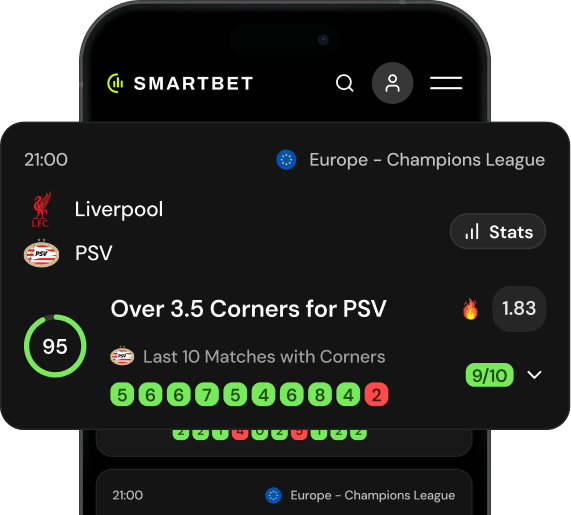
AI-enhanced analysis can process fixture data, compare team profiles, identify patterns, and organize a large amount of pre-match context quickly. That is valuable when a full schedule makes manual research inconsistent or time-consuming. Tools such as SmartBet.gg can help turn scattered statistics and match variables into a more repeatable research workflow.
But an AI model does not eliminate uncertainty. Models depend on data quality, assumptions, and the variables they can measure. They may be less reliable when a new manager changes a team's style, a key player returns after a long absence, or a competition has limited historical data. Treat model outputs as probability estimates to investigate, not instructions to follow.
A strong workflow combines model evidence with current, verifiable match context. If the model favors an outcome but the expected lineup substantially weakens that side, the discrepancy is a reason to reassess. Good analysis is not about obeying the tool. It is about using the tool to ask better questions faster.
Protect the Process With Staking Discipline
Even well-researched bets lose regularly. That is normal in a probabilistic activity, which is why stake size should reflect uncertainty rather than confidence alone. Flat staking can be appropriate for bettors who want a simple, controlled approach. More advanced bettors may vary stakes modestly based on perceived edge, but aggressive sizing can turn a reasonable strategy into unnecessary risk.
Before placing a wager, establish a few fixed rules: set a bankroll you can afford to lose, define a maximum stake per bet, avoid increasing stakes to recover losses, and record the reason for every position. A record should include the odds taken, estimated probability, market, stake, and result. Over time, this reveals whether your estimates are calibrated and whether you consistently obtain better prices than the market's closing line.
The ability to pass is part of the edge. There is no requirement to bet every televised match, every rivalry, or every weekend slate. When the information is incomplete, the price offers no margin, or your reasoning depends on a fragile assumption, no bet is often the most rational decision.
Make Each Fixture Earn Your Attention
The best pre-match habit is simple: write down the probability before looking for reasons to force a wager. Then test that estimate against team context, likely lineups, tactical fit, and the available price. If the case remains clear after those checks, you have a decision supported by evidence rather than excitement.
A disciplined process will not remove losing bets, and it should never be presented as a path to guaranteed returns. What it can do is make every decision more accountable. Over a long sequence of fixtures, that is a far more useful goal than trying to predict the next result with absolute certainty.

Articoli Correlati