AI Betting Trends That Matter for Soccer Bettors
AI betting trends are changing soccer research. Learn where models help, where they fail, and how to use probabilities and odds with discipline.

A Saturday soccer slate can produce hundreds of statistics, injury updates, line movements, and social-media opinions before the first match begins. AI betting trends matter because they can reduce that noise into a more structured research process. They do not remove uncertainty or produce guaranteed winners, but they can help bettors evaluate probabilities, identify relevant context, and make decisions with less reliance on instinct.
The AI betting trends changing soccer research
The most meaningful change is not that an algorithm can pick a scoreline. It is that AI can process more variables than a person can reasonably review before every fixture. Team form, shot quality, home and away splits, rest days, player availability, historical matchups, tactical patterns, and market prices can be assessed together rather than in isolation.
For soccer bettors, that changes the starting point. Instead of beginning with a favorite team or a headline result, the research process can begin with a probability estimate. The key question becomes: does the available price appear higher than the likelihood of the outcome?
That distinction is central. A prediction can be directionally correct and still be a poor bet if the odds already account for it. AI is most useful when it supports value evaluation, not when it is treated as an authority that must be followed.
From raw stats to match context
Basic statistics remain useful, but isolated numbers often mislead. A team may have won four straight matches while facing weak opponents, benefiting from red cards, or converting chances at an unusually high rate. Another team may have a poor recent record despite creating strong chances and dealing with a difficult schedule.
AI-assisted football analysis can help organize these signals. Rather than simply counting wins, a model can weigh the quality of chances created and conceded, opponent strength, venue, lineup changes, and the time between fixtures. This gives bettors a fuller view of performance than the league table alone.
The trade-off is that more data does not automatically mean better insight. If the inputs are incomplete, outdated, or poorly weighted, the output can look precise while resting on weak foundations. A probability such as 58 percent is only useful when the underlying model is calibrated and the relevant match context has been captured.
Prédictions Footballistiques Basées sur les Données
Analyses de matchs basées sur l'IA utilisant la forme de l'équipe, les statistiques clés et les paris à valeur pour soutenir les décisions de paris plus intelligentes.
Consultez les prédictions
Probability models are becoming more specialized
Early sports models often focused on broad win, draw, and loss projections. Current AI systems increasingly address narrower questions: whether both teams are likely to score, how many goals a match may produce, whether a first-half market differs from the full-match outlook, or how a missing defender changes expected goals conceded.
That specialization reflects the nature of soccer betting. A match can have a clear favorite but still offer limited value in the moneyline market. The more interesting question may sit in an Asian handicap, a total-goals line, or a team total. Different markets require different assumptions, and a serious model should not treat them as interchangeable.
Low-scoring sports also demand humility. A single penalty, deflection, or early red card can transform a well-reasoned pre-match position. AI can estimate distributions of possible outcomes. It cannot eliminate the variance built into a 90-minute match.
Market movement is now part of the data set
Odds are not just prices to compare at the end of research. They contain information. A line can move because of confirmed lineup news, injury reports, betting volume, or a broader reassessment of a team. AI tools can monitor those changes more consistently than a bettor manually checking multiple markets.
Still, line movement should be interpreted, not copied. A shortening price may reflect meaningful information, but it may also remove the value that existed earlier. Chasing a move after the market has adjusted is not the same as identifying value before it does.
Where AI has limits in soccer betting
AI works best on patterns that can be measured. Soccer contains plenty of them, but it also contains variables that are difficult to quantify. A manager may rotate unexpectedly before a European fixture. A player may be technically available but short of match fitness. Weather, motivation, and tactical changes can matter without appearing clearly in a historical data set.
This is why model outputs should be treated as estimates, not verdicts. The best workflow combines a statistical baseline with a final human review of team news, likely lineups, schedule pressure, and the specific market price.
Data quality matters more than model complexity
A sophisticated model built on unreliable player-status data or inconsistent league coverage can perform worse than a simpler approach using clean inputs. This is especially relevant outside major leagues, where detailed event data, injury information, and reliable expected-goals records may be less available.
Bettors should also be cautious with tools that show confidence scores without explaining what they represent. Confidence may describe the model's separation between outcomes, the amount of historical data available, or a marketing label with little analytical meaning. It is not a promise that a selection will win.
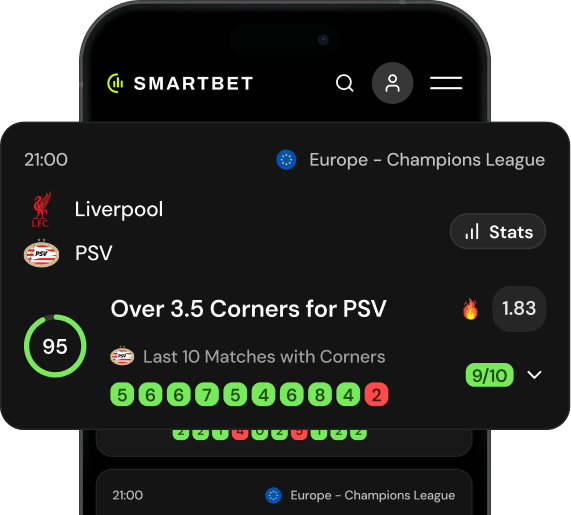
A useful AI platform should make its reasoning easier to inspect, including the football statistics that matter. Users should be able to see the relevant form indicators, scoring trends, matchup context, and probability estimates that support an assessment. SmartBet.gg is built around this decision-support approach: using data to structure research while leaving the final wagering decision with the user.
Prédictions Footballistiques Basées sur les Données
Analyses de matchs basées sur l'IA utilisant la forme de l'équipe, les statistiques clés et les paris à valeur pour soutenir les décisions de paris plus intelligentes.
Consultez les prédictionsHistorical patterns can break
Models learn from the past, but teams do not stay static. A new coach can alter pressing intensity, defensive shape, and chance creation within weeks. A transfer window can change a squad's quality. Promoted clubs, youth-heavy lineups, and midseason tactical shifts can all create conditions that historical averages do not fully explain.
The practical response is not to abandon data. It is to apply it with appropriate weight. If a model relies heavily on last season's results while a team has changed its manager, striker, and defensive system, the estimate deserves more skepticism. The more a fixture differs from the data behind it, the less certainty a bettor should attach to the output.
How to use AI betting trends without outsourcing judgment
Start with the model's probability, then compare it with the implied probability in the odds. Decimal odds of 2.00 imply roughly a 50 percent chance before accounting for bookmaker margin. If your research supports a materially higher probability, there may be value. If the model estimate and market price are close, passing can be the disciplined choice.
Next, test the estimate against current information. Confirm the likely starters, recent workload, injuries, suspensions, and incentive structure. A model may rate a team strongly based on season-long performance, while a depleted lineup materially changes the match.
Then consider the size of the edge, not just the direction of the pick. Small projected advantages are vulnerable to model error and market margin. A larger gap between estimated probability and implied probability may be more interesting, but only when the assumptions are credible. There is no universal threshold because market quality, league coverage, and model calibration differ.
Finally, record the decision. Track the probability estimate, odds taken, market, reasoning, and eventual result. Over time, this separates a repeatable process from selective memory. A losing bet can be well reasoned, and a winning bet can be poorly priced. The goal is to evaluate decision quality across a sample, not to judge every prediction by one final score.
The trend worth following is better discipline
The future of AI in betting is less about dramatic predictions and more about faster, clearer analysis. Tools will continue to improve at filtering information, modeling match scenarios, and highlighting potential price discrepancies. But the bettor who benefits most will be the one who understands what the numbers can say, what they cannot say, and when no bet is the most rational outcome.
Use AI to make your research more consistent, not to hand over responsibility. In soccer, uncertainty is not a flaw in the process. It is the reason price, probability, and disciplined judgment matter in the first place.

Articles Associés