How to Identify Value Bets in Football Markets
Learn how to identify value bets in football by comparing implied probability with evidence, context, and your own disciplined price estimates in markets.

A popular team can be the best side on the field and still be a poor bet at the available price. That distinction is the foundation of how to identify value bets. Value is not a prediction that a result will happen. It is an assessment that the odds offered by a market are higher than the probability you assign to that outcome.
For football bettors, this shifts the question from "Who will win?" to "Is this price fair?" A disciplined process accepts that strong positions can lose on a single match. The objective is to make decisions where the price, over a meaningful sample, gives you a positive mathematical edge.
What Value Means in Football Betting
A value bet exists when your estimated probability of an outcome is greater than the probability implied by the odds. If you believe a team has a 55% chance of winning, but the available odds imply only a 48% chance, the market may offer value. If your estimate is wrong, of course, it is not value. This is why the quality and consistency of your probability process matter more than confidence alone.
Value is also not the same as a long shot. A 6.00 underdog can be overpriced, fairly priced, or underpriced. The same is true of a 1.50 favorite. Odds tell you what the market is charging for an outcome, not whether that price represents a sound decision.
Markets are often efficient, especially in major leagues with high liquidity and extensive public information. That does not make them perfect. Prices move because of new team news, public sentiment, model disagreements, and bookmaker risk management. Your task is not to assume the market is wrong by default. It is to identify the relatively rare moments when your evidence supports a meaningfully different probability.
How to Identify Value Bets With a Repeatable Process
Turn odds into implied probability
Start by translating the price into probability. For decimal odds, the basic calculation is 1 divided by the decimal price. Odds of 2.50 imply a 40% chance before accounting for the bookmaker's margin.
For American odds, positive odds use this formula: 100 divided by the odds plus 100. At +150, the implied probability is 40%. For negative odds, divide the absolute odds by the absolute odds plus 100. At -150, the implied probability is 60%.
These figures are not yet the market's clean estimate because sportsbooks build margin into every market. If the implied probabilities across all outcomes add to more than 100%, that excess is the overround. In a two-way market, prices implying 54% for one side and 51% for the other create a 105% total, meaning a 5% margin is embedded in the market.
You do not need to remove the margin perfectly to make every decision, but you should recognize it. A small apparent edge can disappear once the bookmaker's built-in cost is considered. Look for enough separation between your number and the market number to justify uncertainty in both estimates.
Prédictions Footballistiques Basées sur les Données
Analyses de matchs basées sur l'IA utilisant la forme de l'équipe, les statistiques clés et les paris à valeur pour soutenir les décisions de paris plus intelligentes.
Consultez les prédictions
Build an independent probability estimate
Your probability should be based on evidence that has a plausible relationship with match outcomes, not on a collection of convenient narratives. Begin with a team’s underlying performance over an appropriate sample. Expected goals, shot quality, chance creation, chance prevention, possession progression, and set-piece performance can reveal more than a short run of final scores.
Context determines how much weight those numbers deserve. A team that has posted elite attacking statistics against weak opponents may not carry that level into a match against a well-organized defense. Conversely, a side with poor recent results may have played a difficult schedule or produced better chance quality than its record suggests.
Player availability needs the same treatment. The absence of a high-volume scorer, a key ball-progressing midfielder, or a first-choice center back can change the shape of a team more than a generic injury headline suggests. Consider likely replacements and tactical adjustments rather than simply counting unavailable players.
Home advantage, travel, rest days, weather, fixture congestion, and match importance can all matter, but their influence is situational. A title race, relegation battle, or two-leg European tie may affect lineup choices and game state incentives. These factors should adjust a data-led baseline, not replace it.
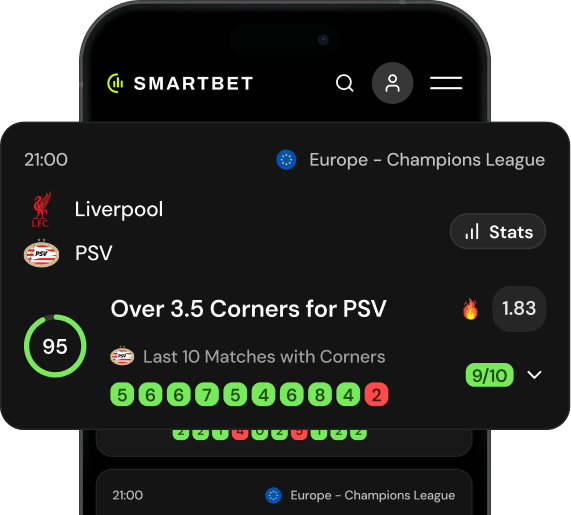
An analytics platform such as SmartBet.gg can help organize team data, fixture context, and modeled probabilities quickly. It is decision support, not a substitute for judgment. The relevant question remains whether the available price is attractive relative to a reasoned estimate.
Compare your number with the available price
Once you have a probability, compare it directly with the odds. Suppose you estimate that both teams will score at 58%, and the market offers 1.95. Those odds imply roughly 51.3% before margin. The gap may be meaningful, but only if your 58% estimate is grounded in stable information rather than a reaction to two recent high-scoring games.
Expected value provides a useful check. With decimal odds, multiply your estimated probability by the odds, then subtract one. In this example, 0.58 multiplied by 1.95 equals 1.131. Subtract one and the expected value is 0.131, or 13.1% per unit staked in theory.
That calculation is only as credible as the probability behind it. A model can produce precise-looking numbers while hiding fragile assumptions. Treat probabilities as ranges rather than certainties. If a realistic error range puts your estimate between 52% and 58%, a price implying 51.3% is less compelling than it first appeared.
Ask what the market may already know
Before labeling a price as value, challenge your own case. Has the line already moved because the market has incorporated the injury, tactical matchup, or scheduling issue you spotted? Are you relying on information that is obvious and widely available? Is a dramatic recent performance distorting your estimate?
This step protects against confirmation bias. Football markets can appear wrong when the available odds actually reflect a factor that is not visible in headline statistics, such as an expected lineup rotation or a goalkeeper's fitness concern.
It also helps to compare related markets. If a team looks unusually cheap to win, check the draw-no-bet, Asian handicap, total-goals, and both-teams-to-score prices. A coherent market across several lines can reveal whether your perceived edge is specific to one price or based on a broader misunderstanding of the match.
Track decisions, not just outcomes
A single result says very little about whether a bet was good. A favorite can dominate and lose. An underdog can score from its only shot and win. If you evaluate every decision only through the final score, variance will push you toward emotional conclusions.
Record your estimated probability, the odds taken, the closing odds, the market, the reasoning, and the outcome. Closing-line movement is not a guarantee of quality, but consistently taking prices that shorten can be a useful signal that your process is finding market support. More importantly, the record exposes patterns: overconfidence in certain leagues, weak estimates for player absences, or a tendency to overreact to form.
Avoiding False Value Signals
The most common mistake is mistaking a compelling story for an edge. A derby atmosphere, a revenge angle, or a team “needing it more” may affect a match, but these themes are difficult to quantify and are often already reflected in the price. Use them cautiously and only alongside evidence.
Another mistake is treating every model disagreement as an opportunity. Models can miss lineup news, use outdated inputs, overfit to historical data, or assign too much importance to a narrow stat. A difference between a model and a market should begin research, not end it.
Finally, avoid forcing action. There will be full fixture lists with no price that clears your threshold. Passing is part of a value-based approach. The number of bets you make is not a measure of analytical quality.
The most useful habit is to make every price earn your attention. Estimate the probability, test the assumptions, account for uncertainty, and accept that even sound decisions lose regularly. That is a more durable approach than chasing certainty in a market that does not offer it.

Articles Associés