What Makes the Best Football Match Prediction Site?
Find the best football match prediction site by comparing data quality, probability models, market context, and responsible research tools for bettors.

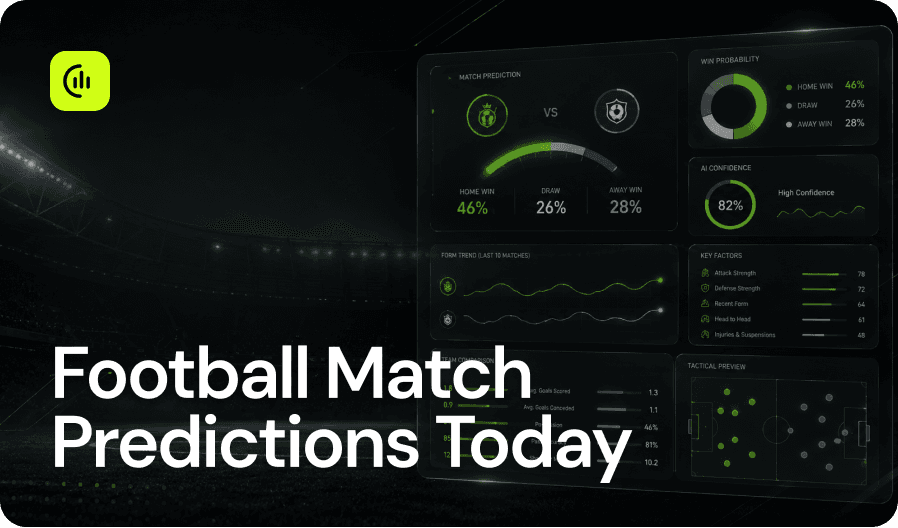
A convincing pick for Saturday's headline fixture is easy to find. A useful process for deciding whether that pick deserves your attention is much harder. The best football match prediction site is not the one that makes the boldest calls or posts the longest winning streak graphic. It is the one that helps you assess a fixture with evidence, understand uncertainty, and compare a predicted outcome with the price available in the market.
That distinction matters because a prediction and a betting decision are not the same thing. A team can be the most likely winner and still be a poor wager if the odds leave no room for error. Good football research starts with probabilities, context, and price rather than certainty.
What the Best Football Match Prediction Site Should Do
A high-quality football prediction platform should make the reasoning behind a match assessment easier to inspect. That does not mean every model must reveal proprietary code or reduce football to one score. It means users should be able to see the inputs and context that support an outlook: recent performance, longer-term team strength, home and away splits, scoring trends, injuries, schedule pressure, and market movement where relevant.
The objective is decision support. A site should organize information that would otherwise take hours to gather across league tables, match reports, team pages, and odds screens. It should not ask users to accept unexplained selections because an anonymous tipster says a result is “locked.”
Useful platforms also distinguish among markets. A match-winner forecast, an over/under assessment, both-teams-to-score probability, and a handicap projection answer different questions. Treating them as interchangeable leads to weak analysis. A team may have a strong chance of avoiding defeat while the total-goals environment points toward a low-scoring match. One broad “pick” cannot capture that nuance.
Prediction Accuracy Is Only Part of the Picture
Many bettors begin by asking which site has the highest accuracy rate. It is a reasonable question, but on its own, it can be misleading. A service that repeatedly predicts heavy favorites will often produce a high win rate. If those favorites are consistently priced too short, that record may not translate into good betting decisions.
Probability calibration is more informative. If a model assigns a 60% chance to a type of outcome across a large sample, those outcomes should occur roughly 60% of the time over the long run. No model will be exact in every short stretch, and football contains plenty of noise. Red cards, late injuries, rotation, weather, and individual finishing variance can change a match quickly. But a well-calibrated model gives users a more realistic basis for comparing its estimate with market odds.
Look for probability ranges rather than language designed to create false confidence. “Home win: 52%” is more useful than “home win guaranteed,” because it tells you both the favored side and the remaining chance of other outcomes. It also makes a value comparison possible. If implied odds suggest a 58% chance while the model estimates 52%, the apparent favorite may not offer value at that price.
Data Quality Determines the Quality of the Output
AI can process large volumes of football data quickly, but the quality of its output depends on the quality and relevance of its inputs. A credible site should account for more than a team’s last five results. Short-term form matters, yet results alone can conceal poor underlying performances, soft opponents, fortunate finishing, or a difficult schedule.
A stronger evaluation combines several time horizons and the right football statistics. Season-level data provides a baseline for team quality. Recent matches can reveal tactical changes, fitness concerns, or momentum. Home and away performance adds context, especially in leagues where travel, climate, and stadium conditions meaningfully affect results. Head-to-head data can be interesting, but it deserves limited weight when coaches, squads, and tactical systems have changed.
Lineup information is another important test. A model that treats every player absence equally will miss the point. Losing a high-volume creator, a dominant center back, or a goalkeeper can alter a team’s profile more than losing a rotational player. At the same time, headline injury news is not automatically decisive. Strong squads can absorb absences, and markets often react rapidly to well-known news.
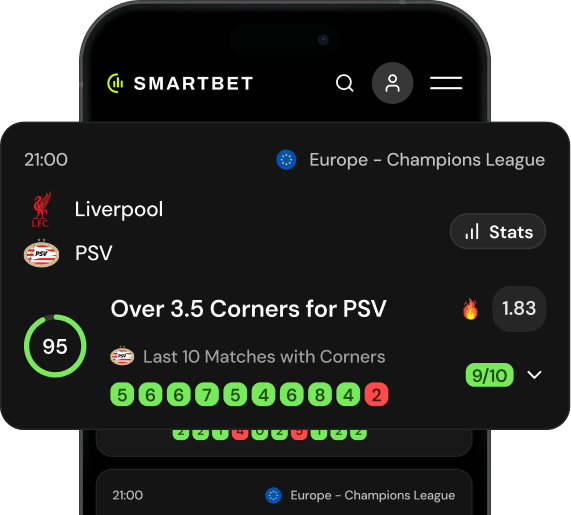
The most useful tools present these factors as context, not as isolated statistics. SmartBet.gg, for example, is designed to bring match data, probability modeling, and pre-match analysis into one structured research process. The user still decides whether the available evidence supports a wager.
Prognósticos de Futebol Baseadas em Dados
Análise de partidas orientada por IA usando forma de equipe, estatísticas-chave e apostas com valor para apoiar decisões de apostas mais inteligentes.
Verificar Prognósticos
How to Compare Model Probabilities With Odds
Odds are not a verdict on a match. They are a market estimate that includes bookmaker margin and changes as information and money enter the market. This makes odds comparison central to identifying value.
Start by converting decimal odds into an implied probability. Divide 1 by the decimal odds, then multiply by 100. Odds of 2.00 imply 50%; odds of 1.67 imply roughly 59.9%. These figures are not perfectly clean probabilities because the bookmaker’s margin is built into the market, but they are a practical reference point.
Suppose a prediction site estimates a team has a 48% chance of winning and the available odds are 2.30. Those odds imply about 43.5%. The gap may indicate potential value, assuming the estimate is well supported and the market has not missed key information. If the same team is priced at 1.95, implying about 51.3%, the model and price point in the opposite direction.
A small gap is not automatically actionable. Model uncertainty, market liquidity, lineup ambiguity, and the limits of the data all matter. For lower leagues or early team-news windows, estimates may deserve a wider margin of caution. The point is not to force action on every fixture. Passing is often the disciplined choice.
Warning Signs in Football Prediction Content
The easiest way to assess a site is often to notice what it refuses to explain. Be skeptical of guaranteed wins, claims of “fixed” information, aggressive urgency, and screenshots without a transparent record. Football betting involves risk, and any platform presenting certainty is selling a feeling rather than an analytical process.
Be cautious with selective performance reporting as well. A record that highlights winners without documenting losses, odds ranges, market type, or sample size tells you very little. Ten successful selections can be memorable. They are not enough to establish whether a method works over time.
Other warning signs include vague phrases such as “the algorithm likes it” with no supporting context, identical recommendations across unrelated markets, and analysis that simply repeats recent scorelines. Good research should explain why a number may differ from the consensus, not just announce that it does.
A Practical Way to Use a Prediction Platform
Use a site as the first stage of research, not the final instruction. You can also compare model-led selections on the Value Bets page. Begin with the match probability and identify which market the analysis actually addresses. Then review the factors most likely to move the estimate: expected lineups, recent tactical changes, home and away splits, rest days, and the quality of recent opponents.
Next, compare the probability with current odds from the operator you use. Ask whether the difference is meaningful after allowing for uncertainty. If it is not, there is no requirement to bet. Save the match, monitor team news, or move on to another fixture.
Finally, keep a record of your own decisions. Track the market, odds taken, rationale, and result. Over time, this reveals whether you are following a consistent value-based process or reacting to narratives after the fact. It also helps separate a poor outcome from a poor decision. A well-priced bet can lose, and a poorly priced bet can win.
The Right Site Supports Better Judgment
The best football match prediction site will not remove uncertainty from football, and it should not pretend otherwise. Its value comes from making uncertainty measurable: showing probabilities instead of promises, supplying relevant data instead of noise, and helping users evaluate whether a market price is worth consideration.
Treat predictions as evidence, not instructions. When a platform improves the quality and speed of your research while leaving room for disciplined judgment, it is doing the job that matters.

Posts Relacionados