How Value Betting Football Odds Actually Work
Learn how to assess value betting football odds with implied probability, independent estimates, market context, and disciplined bankroll choices over time.

A 2.20 price on a football match can look attractive because it offers more than even money. That alone says nothing about whether it is a good bet. Value betting football odds are about the relationship between a bookmaker's price and a realistic estimate of the event's probability - not whether a team is popular, a pick feels convincing, or the potential payout is large.
That distinction matters because betting markets are built to make every outcome look tradable. The disciplined question is narrower: is the available price higher than the fair price suggested by your analysis? If the answer is consistently yes, you may have identified value. If it is no, passing is often the most rational decision.
What value betting means in football
A bet has theoretical value when its implied probability is lower than your independent probability estimate. Suppose a team is priced at decimal odds of 2.50. Those odds imply a 40% chance of winning, calculated as 1 divided by 2.50. If your analysis estimates that team has a 46% chance, the market price may offer value.
The word “may” is doing real work here. Your probability estimate is not a fact. It is a model-based judgment that can be wrong because of incomplete team news, an incorrect assumption about tactical matchups, or simple variance. Value betting is not a way to predict every match correctly. It is a process for seeking better prices than the probabilities you assign.
The basic expected-value calculation is straightforward:
Expected value = (your probability × decimal odds) - 1
Using the 46% estimate at 2.50 odds: 0.46 × 2.50 = 1.15. Subtract 1, and the expected value is 0.15, or 15% per unit staked in theory. A positive figure does not guarantee a win on this wager. It indicates that, if your estimate is accurate and similar opportunities are repeated, the price is favorable over a large sample.
Start with implied probability, not the payout
Odds are easiest to evaluate when converted into probability. Decimal odds are common in international football markets, while US bettors may also see American odds. The conversion lets you compare prices across operators and, more importantly, compare the market view with your own.
For decimal odds, divide 1 by the odds. A price of 1.80 implies 55.6%; 2.00 implies 50%; and 3.25 implies 30.8%. For positive American odds, divide 100 by odds plus 100. For example, +150 implies 40%. For negative odds, divide the absolute odds by the absolute odds plus 100. A price of -125 implies 55.6%.
These figures include bookmaker margin. In a standard 1X2 market, add the implied probabilities for home win, draw, and away win. The total will usually exceed 100%. That excess is the overround, which is how the operator builds an edge into the market. A market totaling 106% is not presenting three perfectly fair prices. It is presenting prices with a combined 6% margin before other factors.
This is why comparing one price in isolation is not enough. A team can be the most likely winner and still be overpriced. Conversely, an underdog can lose often while still being the better bet at the right number.
Build an independent match probability
The quality of value betting football odds depends on the quality of the probability estimate behind the decision. Copying a market price, then calling a slightly different number your own forecast, does not create an edge. You need a structured way to assess what the market may be underweighting or overpricing.
For football, start with underlying performance rather than league position alone. Expected goals and other football statistics, including shot quality, chance creation, defensive concession patterns, set-piece performance, and home-versus-away splits, can give a more useful view than a recent scoreline. A 3-0 win can reflect dominance, but it can also reflect three finishes from low-quality chances.
Then add match context. Confirm likely lineups, injuries, suspensions, rest days, travel, fixture congestion, and incentives. A title contender facing a lower-table opponent may still deserve a lower win probability if its most important creator is absent, it has a European fixture three days later, or the opponent's style consistently disrupts its buildup.
Context should refine the model, not replace it. “They need to win” is rarely enough to justify a price. Most teams want points. The useful question is whether motivation changes lineup strength, tactical risk, or game state incentives in a measurable way.
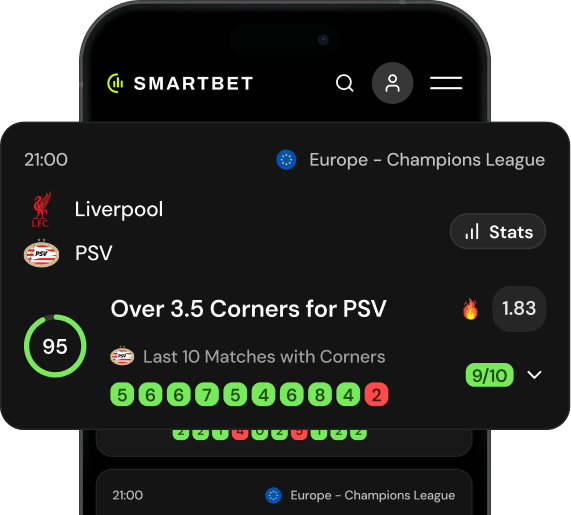
A practical estimate can combine baseline team strength, recent performance adjusted for opponent quality, expected lineup impact, and venue effects. AI-assisted platforms such as SmartBet.gg can speed up this research by organizing performance data, match context, probabilities, and available value bets, but the final probability still requires judgment. A tool can surface signals. It cannot remove uncertainty from a 90-minute match.
Prognósticos de Futebol Baseadas em Dados
Análise de partidas orientada por IA usando forma de equipe, estatísticas-chave e apostas com valor para apoiar decisões de apostas mais inteligentes.
Verificar Prognósticos
Avoid double-counting the same signal
One of the most common forecasting mistakes is treating correlated information as separate evidence. If a team has poor recent results, low confidence, and a bad league position, those may all be consequences of the same underlying issue. Adding a large penalty for each can exaggerate the case against that team.
The same applies to injuries. A missing striker can matter substantially, but the impact depends on replacement quality, system fit, and whether the market has already adjusted. The goal is not to collect the longest list of reasons. It is to estimate how much each factor should change the chance of each outcome.
A quick value betting football odds checklist
Before treating a price as a value bet, run through the same sequence each time:
- Convert the bookmaker's odds into implied probability.
- Consider the bookmaker margin instead of treating the displayed probability as a fair estimate.
- Build an independent probability range using team strength, underlying statistics, lineup information, and match context.
- Convert that estimate into fair odds.
- Compare the fair price with the best available market price and require enough of a buffer for model error.
- Record the odds taken and compare them with the closing line after the market settles.
This checklist does not prove that a selection will win. It creates a repeatable way to decide whether the price is sufficiently different from your estimate to justify further consideration.
Compare your fair odds with the available market
Once you have a probability, convert it into fair odds by dividing 1 by that probability. If you give a home win a 48% chance, your fair decimal price is 2.08. At 2.00, the available market is shorter than your fair line, so there is no value by your estimate. At 2.25, there is a margin between your number and the market price.
That margin should be meaningful. Tiny differences are often noise. If your fair price is 2.08 and one sportsbook offers 2.10, the apparent edge can disappear with a minor lineup update or an overly optimistic assumption in your model. A larger edge is not automatically real, but it gives more room for estimation error.
Price shopping also matters. A 2.20 price and a 2.35 price describe the same match outcome, but they do not offer the same expected value. Over time, consistently taking the best available number is one of the few controllable parts of the process. It also helps to record the closing line. If your selections regularly beat the final market price, that can be evidence that your process is identifying useful information, even through short-term losing runs.
Know where football markets can misprice risk
Major league 1X2 markets are heavily analyzed, particularly close to kickoff. That does not make them impossible to assess, but it means a claimed edge deserves scrutiny. Lower-liquidity leagues, player props, alternate goal lines, and early markets may move more on limited information, yet they also carry wider margins and less reliable data.
Goals markets require special care. A case for over 2.5 goals might rely on two high-scoring teams, but high-scoring histories can be driven by fixtures against weak defenses or unusually high finishing rates. Check chance quality, tempo, lineup changes, and game-state tendencies before assuming prior totals will repeat.
Draw prices are another area where intuition can be misleading. Bettors often prefer a clear winner, while football's low-scoring structure makes draws a material part of many match distributions. If your model routinely assigns too little probability to the draw, both home and away prices can appear more attractive than they truly are.
Treat staking as part of the analysis
A sound price can still create poor outcomes when stakes are too large. Football has high variance: red cards, penalties, deflections, and late tactical changes can overturn an otherwise sensible pre-match read. Stake sizing should reflect both the strength of the estimated edge and the uncertainty around it.
Flat staking is simple and useful for bettors developing a process. More advanced approaches, such as fractional Kelly staking, can scale stakes based on edge and odds, but they depend heavily on accurate probability estimates. If your probabilities are overconfident, full Kelly can expose the bankroll to sharp swings. A conservative fraction is generally more resilient than treating a model output as certainty.
Keep records that include the market, odds taken, estimated probability, stake, result, and closing price. The result tells you what happened once. The record helps show whether your reasoning and pricing discipline are improving across dozens or hundreds of decisions.
The best habit is often the least exciting one: when the price does not clear your fair line by a credible margin, leave the match alone. A structured guide to finding value bets step by step can help turn the same logic into a repeatable pre-match workflow. Good football betting research is not measured by how many picks it produces. It is measured by whether each decision can be explained before the final whistle, managed within a defined bankroll, and reviewed honestly afterward.
Prognósticos de Futebol Baseadas em Dados
Análise de partidas orientada por IA usando forma de equipe, estatísticas-chave e apostas com valor para apoiar decisões de apostas mais inteligentes.
Verificar PrognósticosFrequently asked questions about value betting football odds
What are value betting football odds?
They are bookmaker prices that appear higher than the fair odds suggested by an independent probability estimate. The potential value comes from the difference between price and probability, not from how likely the selection feels to win.
How do you calculate whether football odds have value?
Convert the odds into implied probability, estimate the event's true probability, and calculate EV using (probability × decimal odds) - 1. A result above zero indicates theoretical positive expected value, provided the probability estimate is reliable.
Does a value bet guarantee profit?
No. A value bet can lose, and several value bets can lose in a row. The idea is that consistently taking prices above fair value may produce a long-term edge across a sufficiently large sample.
How large should the edge be before placing a bet?
There is no universal minimum. The required margin should reflect the quality of the data, liquidity of the market, uncertainty around team news, and the likely error in your probability model. Very small differences between your fair odds and the market price are often noise.

Posts Relacionados