What Football Prediction Software Can Do
Football prediction software helps bettors compare probabilities, form, and odds, creating a more disciplined process for assessing every soccer fixture.

A Saturday slate can offer dozens of soccer markets, each competing for attention with headlines, social posts, and confident opinions. Football prediction software gives that noise a structure. Rather than asking a bettor to trust a single pick, it can bring team data, match context, modeled probabilities, and available odds into one research process.
That distinction matters. Software cannot remove uncertainty from a match where a red card, missed penalty, or late tactical change can alter the result. Its value is in helping users make decisions from clearer evidence, identify assumptions, and avoid treating confidence as certainty.
What football prediction software is designed to do
At its best, football prediction software is a decision-support system. It collects relevant information about an upcoming fixture and organizes it around questions bettors actually need to answer: How strong has each team been? Does recent form reflect underlying performance? Which absences matter? What outcome does the model consider most likely? Does the market price appear to account for that probability?
Different platforms answer these questions with different depth. Some focus mainly on predicted scores or match winners. More useful tools provide a broader view, including home and away splits, scoring and conceding trends, expected-goals and other football statistics, head-to-head context, schedule pressure, and market-specific probabilities.
The output should not be mistaken for a verdict. A 58% modeled chance of a home win does not mean the home team will win 58 out of the next 100 versions of that exact game. It is an estimate based on available data and model assumptions. The practical purpose is comparison: whether that estimate differs meaningfully from the probability implied by the odds.
Football Predictions Based on Data
AI-driven match analysis using team form, key statistics and value bets to support smarter betting decisions.
Check predictions
Probability matters more than a predicted winner
A predicted winner is easy to understand, but it is incomplete for betting research. If a model favors Team A, the next question is how strongly it favors Team A and whether the offered price compensates for the remaining risk.
For example, decimal odds of 2.00 imply a 50% probability before accounting for the bookmaker's margin. If an analytical model estimates the same outcome at 54%, there may be a potential value case. If the model estimates it at 47%, the pick may be popular but poorly priced from a probability perspective.
This is why disciplined bettors separate prediction from value. The most likely event is not automatically the best betting option. A heavy favorite can be likely to win and still offer too little return for the risk. An underdog can be unlikely to win outright but potentially priced above its realistic chance. Football prediction software is most useful when it helps make this distinction visible.
Models need context, not blind faith
No model sees the entire match. Data can lag behind a sudden change in tactics, a new manager's effect, an injury that has not been fully reflected in team performance, or a club's motivation in a crowded schedule. Cup matches, derbies, end-of-season fixtures, and games with rotation risk often require more human judgment than a routine league match.
A sound workflow treats the model as a disciplined starting point. Review the probability, then test it against the current context. If the explanation for a potential edge relies on information the data may underweight, reduce confidence or pass. Passing is a valid research outcome when the available evidence is unclear.
The inputs that deserve the most attention
A platform can display hundreds of statistics, but volume is not the same as relevance. The most useful analysis connects data points to a plausible reason they could affect the fixture.
Recent results are a starting point, not a conclusion. A team with four wins may have faced weak opponents or benefited from unusually efficient finishing. A team with two draws may have created high-quality chances and run into strong goalkeeping. Looking beyond the scoreline can prevent bettors from overreacting to short-term results.
Home and away performance also deserves separate treatment. Travel, crowd effects, tactical approaches, and playing conditions can create meaningful splits. A team that dominates at home may be far less reliable on the road, while another may be built to defend and counterattack effectively away from home.
Team news changes the interpretation of historical data. The absence of a central defender, primary ball progressor, or leading striker can affect more than a single statistic. It can alter chance creation, set-piece defense, pressing intensity, and game-state behavior. Software can flag absences and squad information quickly, but bettors should consider whether the player is genuinely central to the team's system.
Finally, assess the schedule. A midweek continental match, a long trip, or an upcoming rivalry game can influence rotation and intensity. These factors do not automatically create an edge, but they can explain why season-long averages are less reliable for one particular fixture.
Choosing the right market after the analysis
A common mistake is forcing every read into the match-winner market. The evidence may point more clearly toward totals, both teams to score, handicaps, or a team-specific goal line.
If both sides generate chances consistently but struggle to keep clean sheets, a goals market may better reflect the underlying pattern than a volatile 1X2 position. If a strong favorite is likely to control the match but faces a compact opponent, a lower-scoring angle may deserve consideration. The right market depends on what the analysis actually supports, not on which market feels most familiar.
This is also where price sensitivity matters. A small difference between modeled and implied probability can disappear once the bookmaker's margin, model uncertainty, and changing team news are considered. There is no universal threshold for value because data quality and league coverage vary. Higher uncertainty calls for more caution, not stronger claims.
A practical process for using the software
Start with a short fixture list rather than trying to analyze every match on the board. Select games in leagues you understand and where the platform has meaningful historical coverage. Narrowing the list reduces rushed decisions and makes it easier to notice when a number looks unusual for a reason.
For each match, begin with the model's probability distribution and compare it with the market. Then review the drivers: recent underlying performance, home and away patterns, injuries, likely lineups, tactical fit, and schedule conditions. Write down the case against your initial view as well. If a bet only makes sense when every favorable assumption holds, it is probably fragile.
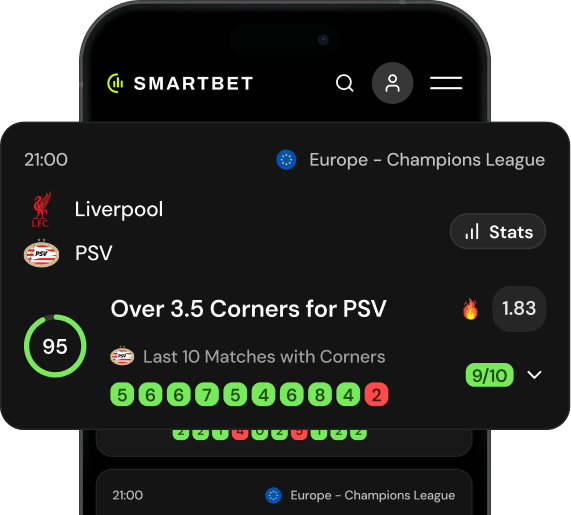
SmartBet.gg can support this process by organizing fixture-level statistics, contextual match analysis, and probability-based insights in one place. The goal is not to outsource judgment. It is to spend less time searching for scattered information and more time evaluating what that information means.
Keep a record of the reasoning behind each wager, not only the result, ideally in a consistent bet tracker. Over time, this reveals whether your strongest decisions came from a genuine pricing edge, a useful market choice, or simply a favorable outcome. It also exposes recurring mistakes, such as overvaluing recent wins, betting too many matches, or entering markets before lineups are confirmed.
Football Predictions Based on Data
AI-driven match analysis using team form, key statistics and value bets to support smarter betting decisions.
Check predictionsWhat software cannot solve
Football prediction software cannot guarantee returns, identify every mispriced line, or protect a bettor from poor bankroll management. Models are estimates, markets move, and bookmakers can be efficient, especially in high-profile leagues. A polished dashboard is not evidence that a bet is worth taking.
It also cannot make risk tolerance decisions for the user. Two bettors can see the same probability estimate and reach different choices based on their bankroll, market access, and confidence in the information. Stakes should be proportionate, losses should be expected, and betting should remain within a budget set before the match analysis begins.
The most useful software does something less dramatic but more valuable: it makes the research process repeatable. When a fixture looks attractive, ask what probability the market implies, what the model estimates, which assumptions support the gap, and what could invalidate it. If those answers are not clear, the disciplined move is to leave the market alone.
A better betting process is rarely built on finding one perfect prediction. It is built on making fewer emotional decisions, respecting uncertainty, and giving every wager the same careful standard of evidence.

Related Posts