Soccer Fixture Analysis Tools That Improve Your Process
Soccer fixture analysis tools help bettors compare probabilities, form, matchups, and market prices before a disciplined wagering decision on every slate.
A Saturday slate can present dozens of matches, hundreds of prices, and no shortage of loud opinions. Soccer fixture analysis tools give bettors a way to reduce that noise. Rather than starting with a favorite team, a recent headline, or a tipster’s confidence level, they organize the evidence that should shape a pre-match decision: team quality, matchup context, probability, and the price available in the market.
The purpose is not to produce certainty. Football remains a low-scoring sport where a red card, penalty, deflection, or lineup surprise can change a match quickly. The practical value of analysis is different: it helps you make more consistent judgments, recognize when the market may already reflect the obvious story, and pass when the available odds do not justify the risk.
What Soccer Fixture Analysis Tools Should Actually Do
The best tools do more than display standings and recent scores. A league table is useful context, but it is a poor substitute for analysis on its own. Teams can collect points through an unusually favorable schedule, late goals, or finishing streaks that are unlikely to continue. Conversely, a strong team may look ordinary in the table after a difficult run of opponents or poor short-term results.
A useful fixture-analysis environment puts performance into context. It should help a bettor compare attacking output, defensive concessions, expected-goal trends, home and away splits, recent opponents, and availability news. It should also make the comparison quick enough to use before odds move or lineups are announced.
The central question is not simply, “Who is more likely to win?” It is, “What probability does this match outcome deserve, and does the market price offer enough compensation for the chance of being wrong?” That distinction separates match prediction from value-oriented betting research.
Prédictions Footballistiques Basées sur les Données
Analyses de matchs basées sur l'IA utilisant la forme de l'équipe, les statistiques clés et les paris à valeur pour soutenir les décisions de paris plus intelligentes.
Consultez les prédictions
The Data That Matters Before a Match
No single statistic decides a fixture. Strong analysis comes from combining indicators that answer different questions about a team’s underlying level and its specific situation.
Team strength and expected goals
Expected goals, commonly called xG, estimate the quality of chances created and conceded. Over a meaningful sample, they can be more informative than raw goals because finishing and goalkeeping often fluctuate. A team scoring far above its expected output may be playing well, but it may also be benefiting from a conversion rate that is difficult to sustain.
That does not mean xG should be treated as a final score prediction. Different models assign chance quality differently, and some teams consistently have stylistic traits that basic models do not capture perfectly. Use it as evidence of chance creation and prevention, then compare it with actual results, shot volume, and the quality of opponents faced.
Form, with context
“Form” is one of the most overused terms in soccer betting. Five straight wins sound persuasive until you see that three came against relegation candidates and two were decided by late set pieces. Five poor results can also hide a difficult schedule or several competitive performances against elite opposition.
A good tool lets you review recent form without isolating it from the wider season. Look at results, but also examine whether the team was consistently creating chances, conceding territory, or relying on narrow margins. Recent evidence deserves weight, especially after a tactical change or key injury, but it should not erase a larger body of performance data.
Squad availability and schedule pressure
The same team can be materially different without its main striker, defensive organizer, or starting goalkeeper. Fixture congestion matters too. A club returning from a midweek European match may rotate, manage minutes, or show a different intensity profile than it would after a full week of rest.
Availability data is most useful when it is specific. “Several absences” is less meaningful than knowing which positions are affected, whether replacements are proven, and whether the missing player’s role is difficult to replicate. Confirmed lineups are especially valuable because they replace assumptions with information, although markets often react quickly when they arrive.
Turning Match Analysis Into Probability
Analysis becomes betting research only when it meets the market. Decimal odds of 2.00 imply a rough 50% probability before accounting for bookmaker margin. Odds of 4.00 imply roughly 25%. These figures do not tell you what will happen. They establish the probability threshold a selection needs to clear to make sense at that price. Understanding expected value in sports betting helps connect that probability estimate with the odds available in the market.
Suppose your assessment gives a home team a 45% chance of winning, while the available odds imply 40%. That gap may indicate value, but only if the estimate is well grounded and large enough to account for uncertainty. A five-point edge based on weak inputs, stale injury news, or a small sample is not much of an edge at all.
This is where market comparison matters. The goal is not to oppose the market automatically. Betting markets aggregate a great deal of information, particularly in major leagues. Instead, use your analysis to identify cases where your structured view differs for a reason: an underappreciated matchup issue, an overreaction to a recent result, or a price that has moved beyond what the new information supports.
A Practical Process for Evaluating a Fixture
A disciplined workflow prevents the common mistake of searching for evidence after choosing a bet. Start broad, narrow the field, and only then decide whether the price is playable.
First, screen today's football predictions and fixtures for meaningful differences in underlying performance, schedule context, or market movement. There is no need to force analysis on every match. A smaller shortlist creates more time for the games where information may matter.
Next, compare each team’s season-level profile with its recent performance. Check chance creation and concession trends, home or away behavior, the strength of recent opponents, and whether results align with the underlying numbers. When the two views conflict, investigate rather than automatically favoring the most recent sample.
Then assess the match-specific details. Consider injuries, suspensions, travel, rest, likely rotations, tactical matchups, and motivation only when it has a credible effect on team selection or performance. Vague narratives about “wanting it more” should carry little weight without supporting evidence.
Finally, translate the view into a probability range and compare it with the price. A range is often more honest than a precise number. If you think a team’s win probability is somewhere between 42% and 46%, an implied probability of 50% is unlikely to be attractive. If the market implies 35%, the fixture may deserve a closer look.
Record the reasoning before placing any wager. Over time, a simple log of estimated probability, odds, market, and outcome can reveal whether your process is calibrated or whether you consistently overrate certain leagues, favorites, or statistical signals.
Where AI Helps — and Where It Does Not
AI-assisted soccer tools can make research faster by processing large volumes of match data, surfacing relevant patterns, and creating structured pre-match comparisons. This is valuable when a bettor is evaluating multiple leagues or trying to separate signal from a crowded fixture list.
The limitation is equally important. An AI model is only as useful as its data, assumptions, and update frequency. It may not fully capture a late tactical adjustment, uncertain player fitness, poor weather, or a lineup decision that is not yet public. A probability model is an input to judgment, not a replacement for it.
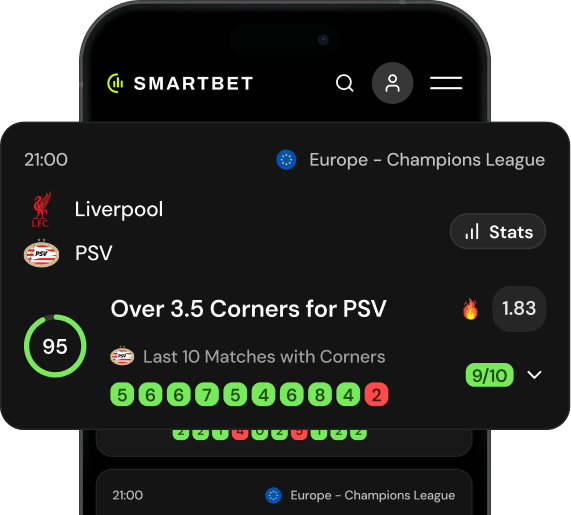
SmartBet.gg is built around that decision-support approach: using statistics, match context, and probability-led analysis to make research more organized. Users can also review football value bets, where model-based probabilities are compared with available market odds. The bettor still decides whether a price is worth taking and whether the uncertainty is acceptable.
Prédictions Footballistiques Basées sur les Données
Analyses de matchs basées sur l'IA utilisant la forme de l'équipe, les statistiques clés et les paris à valeur pour soutenir les décisions de paris plus intelligentes.
Consultez les prédictionsChoosing Tools That Support Better Decisions
The right setup depends on the leagues and markets you follow. A bettor focused on major European competitions may prioritize deep team metrics, lineup information, and liquid-market price movement. Someone assessing a broader range of leagues may place more value on reliable data coverage and fast access to comparative statistics.
Look for tools that explain the inputs behind their outputs instead of presenting unexplained picks. Transparent probability estimates, clear historical context, and filters that help you compare fixtures are more useful than a stream of confident selections. Be cautious with platforms that advertise guaranteed returns, hide their methodology, or frame every match as an opportunity.
Also consider whether the tool improves your behavior. If it helps you slow down, compare probabilities with odds, and skip weak positions, it is doing real work. If it encourages more bets without better reasoning, more information may simply be creating more noise.
A strong fixture analysis process will not remove variance from soccer. What it can do is make every decision easier to explain, easier to review, and less dependent on impulse when the next slate arrives.

Articles Associés