Football Betting Stats That Actually Matter
Use football betting stats to compare team strength, spot context behind trends, and assess whether available odds offer enough value before betting today.

A team can have 65% possession, 18 shots, and still be a poor betting choice. That is the central problem with football betting stats: raw numbers can describe a match without explaining its likely next outcome. Useful research is not about collecting the most data. It is about identifying which signals change a realistic probability estimate and which merely make a case sound convincing.
For bettors, the objective is not to find certainty. It is to assess whether the market price appears too high or too low relative to a disciplined view of the fixture. Statistics are evidence for that view, not a replacement for judgment.
Start With Team Strength, Not the League Table
League position is a convenient reference point, but it is often a lagging indicator. A team may be sitting sixth after a favorable schedule, a series of narrow wins, or unusually efficient finishing. Another may be lower than expected after difficult away fixtures, key injuries, and a run of matches against top opponents.
Expected goals and other football statistics are usually a better starting point. Look at xG created and xG conceded over a meaningful sample, then compare those figures with actual goals. This helps separate sustainable chance creation from short-term finishing streaks.
A side scoring 2.0 goals per game from 1.1 xG is not automatically overrated. Elite finishers and tactical quality can support above-average conversion for periods of time. But the larger and longer the gap becomes, the more carefully it should be tested. The same applies defensively: a team allowing 1.5 xG per match while conceding only 0.6 goals may be benefiting from exceptional goalkeeping, favorable variance, or both.
Use the table as context. Use underlying performance to estimate strength.
Previsioni Calcio Basate su Dati
Analisi delle partite guidata dall'IA utilizzando la forma della squadra, statistiche chiave e scommesse di valore per supportare decisioni di scommessa più intelligenti.
Visualizza previsioni
Football Betting Stats Need a Time Frame
Season-long data offers stability, but it can miss change. Last-five-match data captures recent form, but it is vulnerable to noise. Strong analysis uses both rather than treating either as definitive.
Start with season or longer-term numbers to establish a baseline. Then ask whether there is a credible reason to adjust it. A managerial change, a new striker, a return from injury, fixture congestion, or a tactical shift can all make older data less representative. A run of three wins by itself is not enough.
The quality of recent opponents matters just as much as the results. Beating three bottom-half teams does not carry the same meaning as producing a strong performance against elite opposition. Likewise, a winless run can conceal encouraging data if it came during a difficult stretch of fixtures.
This is where many simple streaks fail. “Unbeaten in six” and “over 2.5 goals in five straight” are descriptions, not predictions. Before treating a trend as relevant, check the opponents, match states, red cards, penalties, and underlying chance quality behind it.
Read Attack and Defense Together
Goals markets, match winner markets, and both-teams-to-score markets all depend on the interaction between two teams. Evaluating one side in isolation creates blind spots.
For an attacking team, examine chance volume, chance quality, shot locations, set-piece output, and the availability of its primary creators and finishers. For the opponent, assess whether it concedes chances centrally, struggles against crosses, allows frequent transitions, or has been protected by low-quality opposition.
A high-scoring team is not always a strong over bet. If its output is driven by penalties, long-range finishing, or a handful of open matches, the next fixture may not support the same goal expectation. Conversely, a team with modest goal totals may be creating enough quality chances to be undervalued, particularly if it faces a defense that gives up similar opportunities.
Home and away splits can help, but they need interpretation. Some teams genuinely press better at home or become more conservative on the road. Others simply have faced uneven schedules. Use splits as a prompt for further analysis, not a standalone rule.
Match Context Can Override the Average
Averages are useful until the conditions change. Football is especially sensitive to personnel and incentives because individual roles can alter chance creation, pressing, defensive coverage, and set-piece threat.
Missing a starting center back is not always worth the same adjustment. The impact depends on depth, tactical structure, and the opponent’s strengths. Losing a fast defender may matter more against a transition-heavy attack than against a team that builds slowly. A missing defensive midfielder can affect both goals conceded and the team’s ability to sustain attacks.
Schedule also deserves attention. A domestic league match between two European fixtures may involve rotation, reduced intensity, or late tactical conservatism. A relegation battle may be more cautious than each side’s season averages suggest. A cup second leg can produce entirely different incentives depending on the aggregate score.
Weather, travel, and rest are rarely sufficient reasons to bet on their own. They become relevant when they reinforce a broader case already supported by team and matchup data.
Compare Probabilities With Odds, Not Predictions With Hopes
The most important calculation in betting is not whether a result seems likely. Understanding expected value helps connect probability with price. It is whether the implied probability in the odds is lower than your informed estimate.
Decimal odds of 2.00 imply a 50% probability before accounting for bookmaker margin. Odds of 1.50 imply roughly 66.7%. If your research suggests a team has a 55% chance to win, odds of 1.50 do not offer value, even though the team may still win more often than it loses.
This distinction protects against a common mistake: repeatedly backing likely outcomes at prices that are too short. Favorites can be correctly favored and still be poor wagers. Underdogs can be unlikely winners and still be worth consideration if the market price creates a meaningful value bet.
No model, dashboard, or analyst can produce a perfectly precise probability. Treat estimates as ranges rather than declarations. If your fair price is close to the available line, uncertainty and bookmaker margin may leave no meaningful edge. Passing is a valid decision.
Avoid Double-Counting the Same Signal
Statistics can create false confidence when several numbers are all measuring the same underlying event. For example, a team’s recent wins, high goal total, strong conversion rate, and positive goal difference may largely come from one finishing streak. Counting each as separate evidence exaggerates the case.
A cleaner process groups evidence into categories: underlying chance quality, tactical matchup, team news, schedule conditions, and market price. Ask whether each category adds new information. If not, reduce its weight.
This is also why head-to-head records should be handled carefully. Matches from previous seasons often involve different managers, players, styles, and incentives. They can be useful when a stable tactical matchup persists, but they are usually weaker evidence than current team performance and availability.
Build a Repeatable Pre-Match Process
The purpose of football betting stats is consistency. A repeatable process reduces the urge to chase narratives after a bad result or force an opinion on every televised match.
Begin by establishing each team’s baseline strength through longer-term attacking and defensive data. Review recent matches for genuine changes, then assess injuries, expected lineups, motivation, travel, and schedule. Compare the resulting probability range with the available odds. Finally, record the reason for the bet, the price taken, and the outcome.
Tracking decisions in a consistent bet tracker matters more than tracking only wins and losses. Over time, review whether your estimated edges were supported by the prices you took, whether you consistently bet worse numbers than the market close, and which assumptions caused errors. A losing wager can be well reasoned; a winning wager can be poorly priced.
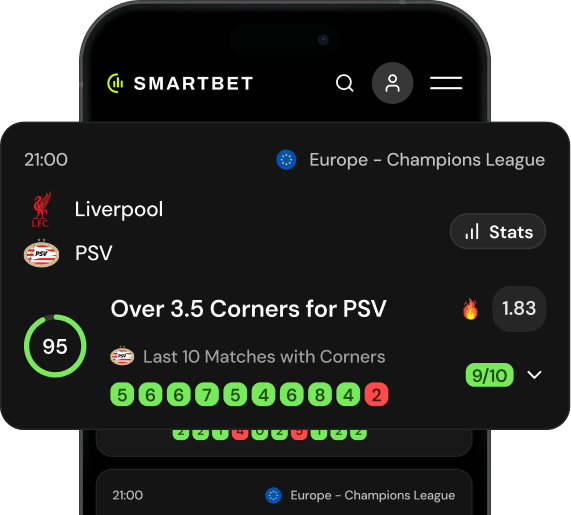
AI-assisted research tools can make this process faster by organizing fixture data, form indicators, matchup information, and probability models in one place. SmartBet.gg is designed around that decision-support role. The final judgment remains with the bettor, and it should include limits that fit their budget and risk tolerance.
A useful stat earns its place by changing how you assess a price. If it does not improve the probability estimate, clarify the match context, or expose a market assumption, it is probably noise. The disciplined move is to keep researching, lower your stake, or leave the match alone.

Articoli Correlati