What Is the Best Way to Predict a Football Match?
What is the best way to predict a football match? Learn a disciplined framework for modeling probabilities, assessing context, and finding value in odds.

A 1-0 win can look convincing on a highlights reel and still reveal very little about the next fixture. A deflected goal, a red card, or one goalkeeper performance can distort the story. So, what is the best way to predict a football match? Build a probability-based view from relevant data, adjust it for match context, and compare that view with the market price.
That process is less exciting than following a viral tipster and more useful over time. Football is a low-scoring sport with high variance. A sound prediction does not claim certainty. It estimates which outcomes are more likely, identifies how confident that estimate should be, and recognizes when the odds already reflect the available information.
The Best Way to Predict a Football Match Starts With Probability
The goal is not to pick the team most likely to win in every game. Favorites win often, but betting markets usually know that. The analytical question is whether a team’s true probability is higher than the probability implied by the odds — the core idea behind value betting.
For example, decimal odds of 2.00 imply roughly a 50% chance before accounting for the bookmaker margin. If your analysis suggests the outcome should occur 56% of the time under comparable conditions, there may be value. If your estimate is 51%, the apparent edge may disappear once uncertainty and market margin are considered.
This distinction separates prediction from betting decision-making. A model can correctly rate a home team as the most likely winner while the best betting decision is to pass because the price is too short. Conversely, an underdog can be unlikely to win but still be priced generously enough to merit consideration.
Predicciones de Fútbol Basadas en Datos
Análisis de partidos impulsado por IA utilizando forma de equipo, estadísticas clave y apuestas de valor para respaldar decisiones de apuestas más inteligentes.
Ver predicciones
Start With Team Strength, Not Recent Scorelines
Final scores matter, but they are noisy. A better starting point is underlying team strength: how consistently a team creates high-quality chances, limits opponents’ chances, and converts territorial control into credible scoring opportunities.
Expected goals and other football statistics, commonly called xG, are useful because they evaluate the quality of chances rather than only whether the ball went in. A team that wins 2-0 from two low-probability shots may not have controlled the match as thoroughly as the score suggests. Another side may lose 1-0 while producing several clear chances and showing a stronger underlying performance.
Use a meaningful sample rather than overreacting to the last match. Seasonal data can establish a baseline, while recent matches can indicate tactical changes, improving form, fatigue, or a decline in performance. The right weighting depends on the situation. A team with the same manager, core lineup, and system may deserve a larger historical sample. A club that changed managers or lost key players may require more emphasis on recent evidence.
Home and away splits also deserve attention, particularly in leagues where travel, crowd influence, pitch conditions, and style create persistent differences. But avoid treating every home record as permanent truth. Ask whether the underlying numbers support it and whether the upcoming opponent presents a similar challenge.
Turn Match Context Into Measurable Adjustments
No model should treat every fixture as if it happens in a vacuum. The best pre-match analysis begins with statistical baselines, then makes disciplined adjustments for information that materially changes expected performance.
The most relevant factors usually include:
- Confirmed or likely absences, especially at goalkeeper, center back, defensive midfield, and striker
- Fixture congestion, travel, rest days, and the demands of recent cup or continental matches
- Tactical matchups, including pressing resistance, set-piece strength, and vulnerability in transition
- Motivation that is supported by a real competitive context, not a vague claim that one team "wants it more"
- Weather, pitch, and venue conditions when they are likely to alter the pace or style of play
Injuries are frequently overvalued when the missing player is famous and undervalued when the player performs a structural role. Losing a high-volume scorer matters, but losing the midfielder who progresses the ball, protects the back line, and enables the team’s system can be just as significant. The key is to assess replacement quality and tactical consequences rather than simply counting absences.
Motivation requires similar restraint. A title race, relegation battle, or second leg can affect team selection and risk tolerance. Yet motivated teams still lose, and teams with little to play for can produce strong performances. Treat motivation as context that may change lineups or tactics, not as a substitute for evidence.
Use Models to Produce Ranges, Not False Precision
A useful football model often estimates expected goals for each side, then converts those estimates into probabilities for markets such as 1X2, over/under totals, both teams to score, or Asian handicaps. Poisson-based scoring models are a common foundation because goals are countable events, although more advanced approaches can account for team ratings, correlation, shot quality, and changing strength over time.
The model matters less than its calibration. If a system assigns 60% probabilities to hundreds of outcomes, approximately 60% of those outcomes should occur over a large sample. A model that is frequently confident and frequently wrong is not useful, even if it occasionally identifies spectacular winners.
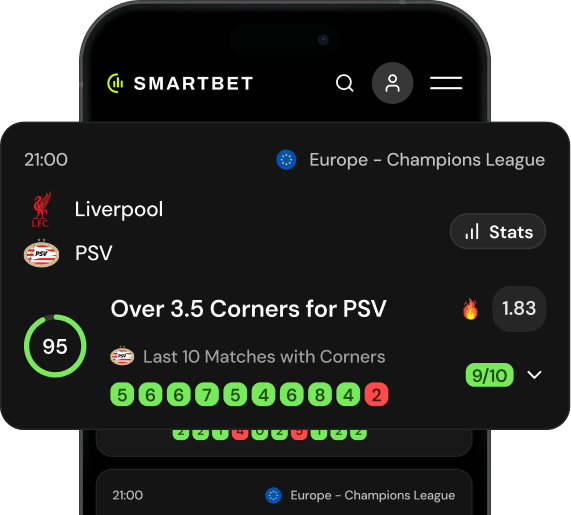
This is where AI-assisted football analysis can help. It can organize fixture data, compare team profiles, flag unusual trends, and surface context that is easy to miss across multiple leagues. It should not be treated as an oracle. SmartBet.gg is designed around that distinction: AI can make research more structured, while the final judgment remains a user decision made under uncertainty.
Avoid becoming attached to a projection with too many decimal places. A 52.7% win probability is not a promise that the team is precisely 52.7% likely to win. It is an estimate based on assumptions, data quality, and the information available before kickoff. Lineup news, tactical changes, and late market movement can reasonably change it.
Predicciones de Fútbol Basadas en Datos
Análisis de partidos impulsado por IA utilizando forma de equipo, estadísticas clave y apuestas de valor para respaldar decisiones de apuestas más inteligentes.
Ver prediccionesCompare Your Estimate With the Entire Market
Odds are not just prices. They are a concentrated form of public information, professional analysis, team news, and market opinion. Ignoring them until the final minute is a mistake. Treat the market as a benchmark your reasoning must beat, not an enemy to dismiss.
Start by converting odds into implied probabilities. Then account for the bookmaker’s margin, since the implied probabilities across all possible outcomes will generally total more than 100%. Comparing fair probabilities rather than raw odds gives a more realistic picture of whether an edge exists and whether a position has positive expected value.
Look beyond the match-winner market when the game profile supports it. If your analysis points to a low-event match, an under total or an Asian handicap may express that view more efficiently than backing a narrow home win. If one team’s defensive structure is strong but its attack is inconsistent, a draw-related market may fit better than a confident 1X2 selection.
However, more markets do not automatically create more opportunities. Niche markets can have lower limits, wider margins, and less reliable information. The best action is often no action when your probability is close to the market consensus or key information is unresolved.
Common Errors That Weaken Football Predictions
The first error is recency bias. One emphatic win does not erase months of weak chance creation, and one loss does not prove a strong team has collapsed. The second is confirmation bias: finding statistics that support a favorite while ignoring evidence that challenges the view.
Another common mistake is double-counting. A bettor may downgrade a team for an injured defender, then also downgrade its recent defensive record that was already affected by the same absence. Each adjustment should have a clear reason. Otherwise, the estimate becomes more emotional than analytical.
Finally, do not confuse a good process with a guaranteed short-term result. A value-based wager can lose, and a poorly reasoned wager can win. Results from a small run of matches are not enough to validate or reject a method. Track projected probabilities, closing prices, bet size, and outcomes over a large sample.
Build a Repeatable Pre-Match Routine
Before considering any football wager, establish a team-strength baseline from chance quality and performance data. Check expected lineups, injuries, rest, travel, and tactical fit. Create a probability range rather than a single emotionally fixed answer. Then compare it with the available odds and ask a simple question: is the difference large enough to justify the uncertainty?
If the answer is unclear, passing is a disciplined result, not a missed opportunity. The best football predictions come from a process that remains consistent when the last bet won, lost, or never happened. Let the evidence set the pace, and let uncertainty keep the decision honest.

Artículos relacionados