Are Football Match Predictions Today Sure Wins?
Football match predictions today sure wins? Learn how to assess probabilities, odds, team news, and value without treating any soccer bet as guaranteed.
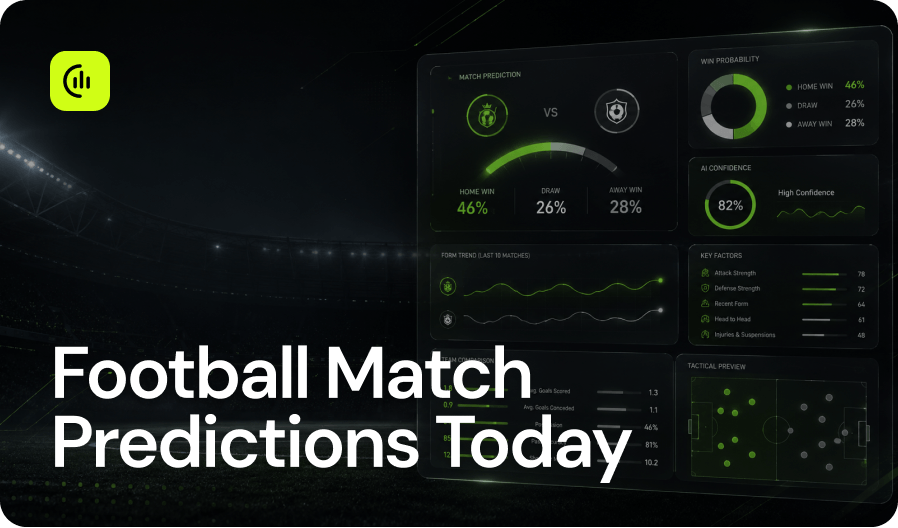
A fixture can look obvious at 10 a.m. and become a very different betting proposition by kickoff. A striker fails a fitness test, a manager rotates after a midweek match, or the market moves before the public has processed the news. That is why searches for football match predictions today sure wins start from the wrong assumption: there are no sure wins in football betting, only estimates with different levels of probability and different prices.
The useful question is not, “Who cannot lose?” It is, “Does the available evidence suggest this outcome is more likely than the odds imply?” That shift replaces tipster-style certainty with a repeatable process. It also recognizes the part that no model, analyst, or AI tool can remove: variance.
Why “sure wins” do not exist in football
Football has a low scoring rate, and low-scoring sports produce outsized variance. A team can control possession, create more quality chances, and still lose to one set-piece goal or a goalkeeper performance that exceeds expectations. A red card, penalty, deflection, or late injury can change a match before pregame analysis has a chance to play out.
Even a heavily favored team is not a guaranteed winner. If a side has an 80% chance of victory, it still fails to win roughly once every five comparable matches. Treating that remaining 20% as irrelevant is how otherwise sensible bettors overstate confidence, chase losses, or stake too much on a single result.
Odds already reflect much of what is publicly known. League position, recent form, star players, home advantage, and headline injury news are usually embedded in the market. Finding an edge requires more than identifying the better team. It requires deciding whether the market has priced that team, total, handicap, or player-related outcome too high or too low.
Football match predictions today: a better way to assess them
A disciplined prediction starts by separating match probability from betting value. Probability asks how likely an outcome is. Value asks whether the price offered is better than your estimated probability warrants.
For example, suppose analysis estimates a home team has a 55% chance to win. Fair decimal odds for that probability are approximately 1.82. If the market offers 1.65, the team may still be the most likely winner, but the wager does not automatically offer value. If the available price is 2.00, the same 55% estimate deserves closer attention.
No estimate is perfect, so precision should not become false certainty. The goal is to create a defensible range based on relevant evidence, then compare that view with the market. SmartBet.gg is built around this decision-support approach: organizing match context and probability-oriented signals so users can research more efficiently, rather than presenting a bet as risk-free.
Predicciones de Fútbol Basadas en Datos
Análisis de partidos impulsado por IA utilizando forma de equipo, estadísticas clave y apuestas de valor para respaldar decisiones de apuestas más inteligentes.
Ver predicciones
Start with the match context, not the league table
League position is useful, but it is a summary, not an explanation. A team may be high in the table because it has converted chances at an unusually efficient rate, benefited from a favorable schedule, or won several close matches. Another may be underperforming its underlying numbers after a difficult run of opponents.
Look at the setting around the fixture. Is this a domestic league match between rested teams, or is one club returning from travel and a demanding European tie? Is the favorite protecting a lead in a two-leg cup tie? Does a relegation-threatened side need points but struggle to create chances against organized defenses? Context determines which statistics deserve the most weight.
Home advantage also varies by team and competition. Some clubs play with a highly aggressive home approach, while others are equally cautious everywhere. Travel distance, climate, pitch conditions, and crowd intensity can matter, but they should not be used as automatic explanations without supporting performance data.
Measure performance beyond recent results
A five-match winning streak is not necessarily proof of sustainable form. Results are affected by opponent quality, penalties, red cards, and finishing variance. A stronger evaluation asks how those results were produced.
Expected goals and football statistics can help distinguish chance creation from scoreline noise. Compare expected goals for and against, shot quality, shots allowed in dangerous areas, and whether the team repeatedly creates high-value opportunities. Also consider the sample. Five games can reveal a tactical change or an injury issue, but it can also be a short-term swing.
Recent form should be adjusted for opponents. Scoring three goals against a weak defense is less informative than creating consistent chances against elite opposition. Likewise, a modest attacking output against several strong teams may not mean an offense has suddenly become poor.
Treat team news as a market-moving variable
Lineups can carry more information than broad season averages. The absence of a central defender may weaken a high line. A missing defensive midfielder can affect transition control. If a team’s main chance creator is unavailable, its possession numbers may hold up while the quality of its final pass declines.
Avoid reducing team news to a simple count of missing players. The question is role and replacement quality. A backup may be a reasonable substitute in one system and a major liability in another. Confirmed lineups are especially valuable for matches with rotation risk, congested schedules, or uncertain player fitness.
Manager comments deserve caution. Coaches may be strategic, vague, or genuinely undecided. Use them as context, not as a standalone signal. The most reliable approach is to revisit a preliminary view when credible lineup information arrives.
Match the market to the evidence
Many bettors default to the 1X2 market because it is familiar. But the clearest analytical case may sit elsewhere. A favorite can be likely to win while its price is too short, whereas an Asian handicap, draw-no-bet option, total-goals line, or both-teams-to-score market may better reflect the actual matchup.
A match between two strong attacks is not automatically an over. If both teams are tactically cautious against comparable opponents, or if one is missing key creators, the total may already be inflated by reputation. Similarly, a match involving a low-scoring team is not automatically an under if its defense has been conceding high-quality chances and the opponent’s style forces open transitions.
Build each position from a specific thesis. Perhaps the home side consistently creates chances through wide overloads, while the visiting fullbacks allow dangerous entries from those zones. Perhaps the underdog’s direct game is well suited to a favorite that commits numbers forward. A thesis can be wrong, but it should be testable and more specific than “this team needs the points.”
Common mistakes when looking for football match predictions today sure wins
The most expensive mistake is confusing confidence with probability. A bettor may feel highly confident after seeing a famous club face a lower-table opponent, but confidence is not evidence that the price is favorable.
Another common error is stacking correlated selections into an accumulator. A favorite to win, score over 1.5 goals, and lead at halftime may all rely on the same match script. The combined payout looks attractive, but the ticket becomes fragile. One early tactical surprise can defeat every leg at once.
Be careful with narratives built around motivation. Teams do not always perform better because a match is “must-win.” Pressure can lead to urgency, but it can also lead to conservative choices, rushed finishing, and tactical imbalance. Motivation matters most when it changes likely lineups, intensity, or game state behavior in a measurable way.
Finally, do not force action because there is a large slate of matches. A full schedule creates more information, not necessarily more value. Passing on a fixture is a valid analytical outcome when the price appears efficient or key inputs remain uncertain.
Use AI and data as decision support, not a substitute for judgment
AI-assisted football analysis is most useful when it reduces research friction. It can surface patterns across fixtures, compare underlying team metrics, flag changes in form, and help organize a large volume of pre-match information. It is less useful when treated as an oracle.
Models depend on data quality, assumptions, and the way football conditions change. A model may not fully capture a new manager’s tactical shift, an unreported fitness issue, or a young player whose role has changed quickly. Human judgment remains necessary to determine whether the model’s historical view fits the match in front of you.
The strongest workflow combines structured data with transparent reasoning and a clear understanding of expected value. Set an initial probability estimate, identify the inputs driving it, check the available odds, and update the view only when new information justifies it. Keep a record of the rationale, price taken, and eventual result. Over time, that record reveals whether your process is identifying value or simply remembering its best calls.
Make uncertainty part of the staking decision
A good prediction can still lose. That reality should shape stake sizing. Smaller stakes are appropriate when the edge is modest, team news is unresolved, or your probability estimate has a wide uncertainty range. Larger exposure should never be justified by the phrase “can’t miss.”
Set a predefined betting budget and treat each wager as one decision in a long series, not a verdict on your football knowledge. Avoid increasing stakes after losses to recover quickly. That response turns normal variance into a bankroll problem.
The most useful prediction for today may not name a guaranteed winner. It may identify a price worth monitoring, explain what lineup news would change the view, or conclude that the market offers no edge. That is not hesitation. It is the discipline that gives football analysis a chance to matter over the long run.

Artículos relacionados